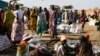



A report by the World Health Organization finds Africa is the region least likely to achieve the health targets set by the U.N. Millennium Development Goals.
This year's World Health Statistics report provides a snapshot of global health trends. It shows significant progress has been made in a number of areas.
The report finds fewer children are dying. Globally, it says less than nine million children under age five died in 2008. This is down by 30 percent since 1990.
It says fewer children are underweight, fewer people are becoming infected with HIV, malaria deaths are decreasing and nearly 90 percent of the world's population has access to safe water.
Despite this progress, the report says the world is not on track to achieve the Millennium Development Goals by 2015. It says the region most off track and least likely to achieve the MDG targets is Africa, and to a lesser extent the Eastern Mediterranean Region.
Carla Abou-Zahr is Coordinator of the Statistics, Monitoring and Analysis Department at the World Health Organization. While the outlook for Africa is generally grim, she notes some African countries are doing much better than others.
"If we just take child mortality, under five mortality, we have seen some enormous declines of over 40 percent in countries as diverse as Eritrea, Malawi, Ethiopia, Mozambique and Niger and Namibia. Several of these countries faced enormous challenges in the 1990s including civil conflict," she said.
Abou-Zahr says progress for some interventions are better than others. For example, she says there is fairly good coverage almost everywhere in areas such as anti-natal care and immunization.
But she notes results are not as good in areas where a functioning health-care system is needed, such as skilled care during delivery or treatment for pneumonia or diarrhea.
"What really epitomizes this need for increased access to health system interventions is the fact that about 40 percent of deaths in children under five years old occur in the newborn period, that very critical time within the first few days and weeks of birth," she said. "And addressing that challenge of newborn mortality is also the same kind of challenge as addressing maternal mortality," said Abou-Zahr.
The report says improving newborn care in the first month of life is essential for reducing child deaths in developing countries. It notes maternal health remains the Millennium Development Goals target for which progress has been most disappointing. Nearly half a million women are estimated to die in childbirth each year.
The report says infectious diseases remain the leading cause of death in Africa and remains a major problem in India. But outside Africa, it says non-communicable diseases, such as tobacco use, alcohol and obesity are the leading cause of death.