


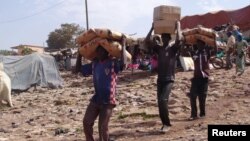
As soldiers in Mali continue working to root out armed militants, aid organizations are navigating rivers and mined roads to bring relief to communities affected by the fighting. Some 36,000 people have fled their homes since fighting began in January, but families who stayed also need help.
Aid agencies say families in northern Mali are running dangerously low on food.
During a small window of calm last week, local transporters working with the U.N. World Food Program were able to get a truckload of food to Gao in northern Mali. But after renewed suicide bombings and street clashes between the military and Islamic militants in Gao, aid agencies are again on stand-by before moving more trucks northward.
Daouda Guirou is with the World Food Program (WFP) in Mali.
He says after the latest incidents in Gao, use of a road is suspended. We are all watching to see how things evolve. He says depending on the security situation, WFP hopes to be able to move supplies by road soon.
Aid agencies are also working to access northern Mali via Niger, but recent unrest also disrupted that plan. Another worry on the roads is mines. There have already been explosions, with a number of deaths and injuries.
Communities in northern Mali are heavily dependent on regional markets for staple foods. USAID’s Famine Early Warning Systems Network says that the continued disruption of trade could lead to serious food shortages.
For the Timbuktu region of northern Mali, the World Food Program is moving food to communities along the Niger River by boat. But this option is for a limited time, as the waters will soon recede.
Of the about 36,000 people who have fled their homes in northern Mali, some have headed for other parts of the country, others over the borders to Burkina Faso, Mauritania, or Niger.
Their number adds to the some 400,000 Malians displaced over the past year.
Karl Nawezi is project manager for Doctors Without Borders in Mauritania, where some 68,000 Malians have sought refuge - about 14,000 of them since January. Just back from a refugee camp near Mauritania’s border with Mali, he said thousands of newly arrived refugees remain without tents and other basic supplies.
Health experts are worried about diarrheal infection and cases of severe malnutrition in the camp.
He says the Malians in Mauritania, Niger and Burkina Faso are totally dependent on outside assistance, and the international community must not forget the people in these camps.
The U.N. has launched an appeal for $373 million to assist the men, women and children affected by the conflict in Mali; so far it is funded at just over 3 percent.
Aid agencies say families in northern Mali are running dangerously low on food.
During a small window of calm last week, local transporters working with the U.N. World Food Program were able to get a truckload of food to Gao in northern Mali. But after renewed suicide bombings and street clashes between the military and Islamic militants in Gao, aid agencies are again on stand-by before moving more trucks northward.
Daouda Guirou is with the World Food Program (WFP) in Mali.
He says after the latest incidents in Gao, use of a road is suspended. We are all watching to see how things evolve. He says depending on the security situation, WFP hopes to be able to move supplies by road soon.
Aid agencies are also working to access northern Mali via Niger, but recent unrest also disrupted that plan. Another worry on the roads is mines. There have already been explosions, with a number of deaths and injuries.
Communities in northern Mali are heavily dependent on regional markets for staple foods. USAID’s Famine Early Warning Systems Network says that the continued disruption of trade could lead to serious food shortages.
For the Timbuktu region of northern Mali, the World Food Program is moving food to communities along the Niger River by boat. But this option is for a limited time, as the waters will soon recede.
Of the about 36,000 people who have fled their homes in northern Mali, some have headed for other parts of the country, others over the borders to Burkina Faso, Mauritania, or Niger.
Their number adds to the some 400,000 Malians displaced over the past year.
Karl Nawezi is project manager for Doctors Without Borders in Mauritania, where some 68,000 Malians have sought refuge - about 14,000 of them since January. Just back from a refugee camp near Mauritania’s border with Mali, he said thousands of newly arrived refugees remain without tents and other basic supplies.
Health experts are worried about diarrheal infection and cases of severe malnutrition in the camp.
He says the Malians in Mauritania, Niger and Burkina Faso are totally dependent on outside assistance, and the international community must not forget the people in these camps.
The U.N. has launched an appeal for $373 million to assist the men, women and children affected by the conflict in Mali; so far it is funded at just over 3 percent.