



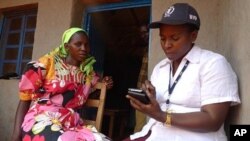
The U.N. World Food Program provides food to about 90 million people in 73 countries. In Burundi, the WFP is using a different technology to determine where exactly to focus their food assistance.
The World Food Program provides food assistance to more than 600,000 "food-insecure" Burundians in a country of eight million people.
WFP-Burundi Public Information Officer Marc Neilson says in order to gauge where there is need, WFP staff go out on fact-finding missions.
"So for example if you enter in a village that the government has recommended as at risk or if based on past studies you may think is at risk, you will do a study in there, and you will ask questions everything from, 'How many meals a day are you eating? How are you cooking? What do you use to cook? What kind of fuel do you have to cook? How many people are in the household?" said Neilson.
WFP program assistant Gerard Bisman is interviewing Elisabeth Tembaidai in Bihogo village in northern Burundi. He is asking her, in the Kurundi language, how much maize she eats each month and where she gets her food.
He is typing her answers directly into a handheld electronic device as part of a new initiative by WFP to use technology to help keep tabs on the country's food situation.
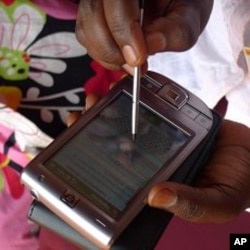
The palmtop computer is a little larger than a normal cell phone. Since he started using the device in March, Bisman says the result is more accurate data, collected faster because there is no prep time and no paper shuffling.
He says it is very interesting to use the device because it is a lot faster. It is used to take him about an hour and a half to complete the entire interview with paper and now it takes only half an hour.
The WFP staffer says the survey takers appreciate the improved technology, too.
Bisman says they used to be very, very tired when we did the survey with pen and paper, but with the 30-minute digital survey, they do not get as tired. A nd so they provide more accurate data, he added.
Tembaidai, a 56-year-old primary school teacher, had never been interviewed by the WFP and said it is the first time for her to see such a device. She said it shows the country is making progress.
A few years ago, Tembaidai received food aid from the WFP because she said there was a food shortage in her village due to a drought. She hopes WFP will provide them with food this year, too.
"We will probably need some help in regards to food this year, because the water that used to come from up north does not come anymore," she said.. "It is the dry season and the village is short of food at the moment."
Neilson said interviewing people like Tembaidai with the electronic devices provides a more precise picture of the needs of the country.
"So you have the speed of gathering data, which means you can expand your survey area and that makes it more valid by interviewing more people," Neilson said.
Right now, WFP Burundi is in Phase One of the project with information collected on a memory card and sent to the main office in Bujumbura. But soon, WFP staff members in the field will begin transmitting their findings wirelessly.
Burundi is one of the poorest countries in the world, with average income per person at about $300 per year. It only emerged from a 13-year civil war in 2006, with one rebel group finally laying down its arms just last year. But the country has a new hi-speed 3G wireless network.
Sending the data wirelessly to the central database to be analyzed will allow the WFP to plan more effectively and quickly where to send food around the country.
Each device costs about $200, so with two devices in each of the 15 provinces, that comes out to about $6,000, not including the cost of training personnel. Neilson said it is a "good investment."
"Anytime you can save doing that, it means those most at risk, the poor, are getting the assistance faster and more effectively, and you are not perhaps going in an area where you really should not be," he said. "WFP needs to be in the areas that are most at risk and that is the bottom line. And so anything that can help improve that process, reduce the time to get there, improve the data, improve the validity of the data, is to me definitely worth the investment."
Neilson said the technological advances have improved the ability of aid organizations like the World Food Program to do their work effectively. The U.N. agency has put the wireless devices to use elsewhere in Africa, including in the Democratic Republic of the Congo and Mozambique.
In the Asia-Pacific region, the U.N. Children's Fund uses hand-held devices to provide a rapid assessment during emergency situations, and in the West African countries of Togo and Niger, the U.S National Centers for Disease Control has got into the act too, using devices with global positioning system capabilities to help prevent malaria.