



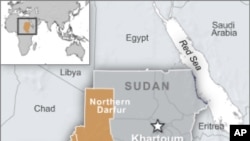
The International Organization for Migration says it is in negotiation with Sudanese authorities to get the government to reverse its decision to expel two senior officials from Darfur. IOM says the departure of its officials will seriously hamper humanitarian operations in the Darfur region.
The International Organization for Migration says it had no forewarning of the expulsion. Spokesman, Jean-Philippe Chauzy, tells VOA the Sudanese authorities have given no explanation for their decision.
"When two of our senior staff members who were heading our offices in Western Darfur and Southern Darfur are expelled, one has to understand that this will have an impact on our humanitarian programs in that part of the Sudan," he said. "We have not yet fully assessed the impact of those expulsions, after all, the announcement was made very recently."
IOM's staff members have been given 72 hours to leave the country. The expulsion order comes only days after the International Criminal Court charged Sudan's President, Omar al-Bashir, with genocide in Darfur.
Last year, al-Bashir expelled 13 foreign aid organizations from Darfur after the ICC charged the Sudanese president with crimes against humanity and issued a warrant for his arrest.
Jean-Philippe Chauzy says IOM will have to rely on its 12 international staff and 70 local staff to carry out humanitarian operations in Darfur after the departure of IOM's two senior officials. He says this will not be easy.
He notes IOM transports all non-food items and assistance for UN agencies and non-governmental organizations, which provides humanitarian aid to internally displaced people in Darfur. He says IOM took over the non-food pipeline after the aid agency, CARE, was expelled in March 2009.
"We also are working to make sure that any return, any relocation of displaced communities will take place on a voluntary basis and in an appropriate matter," said Chauzy. "Voluntary basis means, obviously, that the displaced communities know and are provided with information relating to areas where they might want to return or where they might be relocated. And, appropriate means that we want to make sure that once those displaced communities go back to their areas of origin, that their return is sustainable."
The United Nations estimates 300,000 people have died and 2.7 million have been forced to flee their homes since 2003. That was when war broke out between the Sudanese government supported Arab militia, known as the Janjaweed, and native African groups.