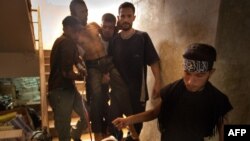
Syrian rebels carry a wounded comrade into a secret field hospital in al-Bab, northeast of Aleppo, August 10, 2012.
Al-Bab Youth Plan for 'Liberated' Syria
AL BAB, Syria – Maybe it was premature, but the students and young professionals of al-Bab decided to celebrate their latest exploits against Syria’s embattled President Bashar al-Assad by marching through the streets of town.
As they marched, a crowd of smiling onlookers cheered and praised Allah for giving them success. Young boys ran alongside the marchers, shouting and flashing “V” for victory signs with their fingers.
Al-Bab is a town of 130,000 in the middle of a rebel-dominated enclave in the northeastern corner of Syria that was “liberated” from Assad’s army last month. It is 30 kilometers from Aleppo, and many of the town’s young men commute daily to join the battle against government forces that have gained an edge in recent days over poorly-armed rebels in what had been Syria’s most populous city.
And each evening, al-Bab’s fighters return home exhausted and unnerved about the course of the topsy-turvy battle still raging half-an-hour away.
Undeterred
But even if Assad’s government forces in Aleppo have gained the upper hand in recent battles, al-Bab’s fighters remain convinced the rebel Free Syrian Army will be able to hold on in the city despite the intensifying air strikes and tank bombardment.
Acting on that conviction of better times ahead, al-Bab’s students and young professionals are trying to create a new political order.
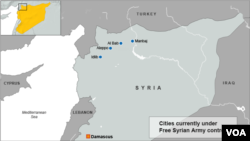
Northwestern Syria Rebel Controlled Areas
Before they marched on a recent evening, the young people had taken their first tentative steps towards democracy, meeting in a crowded hall at a high school with some young imams and the town’s professionals. They wanted to discuss an ambitious agenda that included reorganizing the town government and dealing with the practical challenges of garbage collection and food and gas shortages.
“We are out of the shadow and can decide how to govern in a modern way,” said Mosab Abdul Rachman, a 25-year-old mechanical engineering student.
No women
But asked why no women were present to take part in this new political era, the students initially were taken aback. Finally, a young imam, Mohammed Izmir, responded gently:
“It is not in our tradition for men and women to mix. They can have their own meeting, if they want. And if we need advice on some issues, we can ask them,” Izmir said.
For half-an-hour, a spirited debate ensued among the 200 or so present over who should form the town government.
“Only university educated should be included,” said Abdul Ali, a criminal lawyer.
But not everyone agreed. The debate then shifted to collecting the garbage and dealing with the food and gas shortages. In the end, they decided to postpone any tough decision-making and go for the march instead.
Challenges
Al-Bab isn’t the only town trying to deal with the practical challenges of governing in the enclave rebels have carved out in northern Syria stretching 30 kilometers south from the Turkish frontier and bordered by Idlib in the west to the cities of al-Bab and Manbaj in the east and parts of Aleppo to the south.
Complicating the challenge is that the rebel enclave remains unsafe. In recent days, Assad’s forces have stepped up artillery shelling and airstrikes of some towns in the area, including of Hreitan, Tel Rifat and Azaz, close to where the government still controls the Mannagh military airport.
Travel along the poorly maintained roads is especially hazardous. Circling warplanes have struck targets along the road and shot at cars. On the evening of August 8, a Syrian air force jet attacked a family as members piled into their car on the outskirts of al-Bab, killing an 18-month-old infant and wounding the child’s mother and uncle, relatives say.
But despite the dangers, residents of the small towns in the enclave have felt free enough to begin trying to reorganize how they live. In Azaz, a few minutes drive from the Turkish border, rebel fighters are taking the lead, trying to direct garbage collection and making sure the battered town has electrical power.
In other less strategic towns, residents are left to their own devices. Many are forming self-help committees, often backed by local mosques.
Religion's role
Religious leaders have been at the forefront of the efforts to organize and have been crucial in providing shelter for field hospitals. Many have set up religious courts to adjudicate local disputes.
The religious courts also are trying prisoners captured by the rebels, many of them members of the feared pro-government Shabiha militia that has been blamed for some of the worst atrocities of the 18-month conflict.
“With no courts we had to find some mechanism to handle disputes between civilians and even rebels,” says Abdul Baset-Kuredy, a mosque leader in al-Bab, and one of seven to 10 judges that sit on the town’s new religious court.
He said the court has had cases of Shabiha militiamen but so far has not approved any executions. Before the court was formed at the beginning of August, he said Free Syrian Army rebels had executed several Shabiha gunmen.
Baset-Kuredy said the court has adjudicated 40 cases so far, some involving disputes between civilians and rebels over looting.
“Rebels are humans and make mistakes,” he said. “We follow Sharia law. We are all Sunni Muslim here. What other legal code should we follow?”