



News / USA

Americans Avoid Being the 'Middle' Man

Commuters grab the window or aisle seat but leave the center spot open

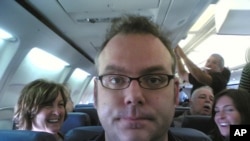
This fellow is clearly THRILLED to have been assigned a center seat.

Multimedia

Audio
TEXT SIZE - +
Ted Landphair

You probably missed The New York Times  photograph that showed a revealing picture of New Yorkers’ rides into work on commuter trains.  The photographer stood behind a long series of rows, three seats to a row.  In the photo, every window and aisle seat - and not ONE middle seat - is occupied. The train is otherwise crowded; the aisles are jammed with standees - all of them ignoring the available middle seat.  Some people are even sitting on the floor.

The accompanying story explores why Americans despise center seats, though not mentioning the unavoidable fact that many of us are, shall we say, rather husky.  

It seems that women, in particular, feel uneasy sitting elbow-to-elbow with strangers.  And while being jammed into a window seat even farther from the middle aisle can also seem claustrophobic, at least there’s a view. 
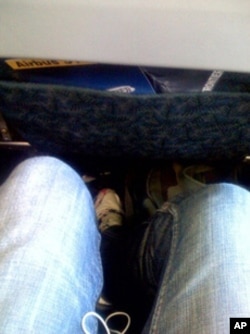
My, but this row offers a lot of legroom. Plenty of room next to you if you get the middle seat, too, no doubt.

For the poor sap in the middle, there’s a real possibility of being squished between the extremely obese, insufferably chatty, overly perfumed or repulsively unbathed.  So, before or after a tiring day, a lot of people would rather stand.

One Times  reader amplified passengers’ dread of middle seats in a letter to the editor.  He wrote, "The chance of being physically squeezed, unwillingly drawn into neighboring cell-phone conversations, entering the ‘smell zone’ of foods eaten onboard, or being subjected to music via the earplugs of excessively loud iPods is just too great to risk."

And Americans’ aversion to close contact is even spreading to rail cars and buses with TWO-abreast seating.  To keep the seat next to them open, some surly commuters lay down a backpack, purse, or lunch pail next to them; slouch across both seats; or glare menacingly at standing passengers, daring them to sit down.

Of course, if these seat hogs would pick a train with three-abreast seating and grab a window or aisle seat, the seat next to them would almost surely stay empty the entire trip!

You May Like

Pakistan Reiterates Opposition to US Drone Strikes

Day earlier US President Barack Obama justified 'constrained' drone usage to save lives More

Study Identifies Risks of Human Spread of H7N9 Bird Flu

Study suggest that international measures to contain the H7N9 influenza, in the event of severe outbreak, will need to be targeted in Asia More

Violence Continues in Conakry Over Upcoming Elections

Opposition has called for boycott of elections More

Video Syria's Civil War Fuels Violence in Iraq

Analysts say al-Qaida-linked militants are flowing back and forth from both countries More

Video Star Trek Influence Lives Long and Prospers

As new movie thrills, many are once again discussing the iconic franchise's influence on society, science and technology More

OECD: Developing Green Cities Key to Sustainable Future

OECD suggests strategies to mitigate rapid growth, industrialization in urban centers, which produce about two-thirds of greenhouse gas emissions More

This forum has been closed.
Comments
     
There are no comments in this forum. Be first and add one

Featured Videos

Your JavaScript is turned off or you have an old version of Adobe's Flash Player. Get the latest Flash player.
Video

Video Volunteers Help Revive LA's Concrete River

The Los Angeles River is a concrete drainage channel through much of its 80-kilometer length. It channels waste-water from storm drains and has become a receptacle for much of the city's trash. But as Mike O'Sullivan reports, the river is slowly being restored with the help of volunteers, who take part in an annual clean-up.