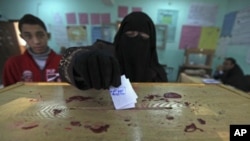



A leader of Egypt's Muslim Brotherhood says the group's Freedom and Justice Party (FJP) is committed to working with others across the political spectrum, even as it appears poised to assume an outright majority in parliament. But some question whether the pledge of pluralism is sincere or simply an attempt to spread responsibility for leading Egypt through troubled times.
There are two consistent and seemingly contradictory arguments made by the front-running party in Egypt's elections. First, that the Muslim Brotherhood will embrace everyone as it seeks to solve the nation's problems. And second, that the answer to those problems can be found in their slogan: "Islam is the solution."
The group's ideology is based on the premise that Islam is central to everything from family life to national government. But the group is trying its best to remedy concerns that premise might carry for Egypt's Christians, secularists, and others should the Brotherhood win an outright majority after this week's third phase of voting.
Essam el Erian, deputy head of FJP, says the party won't deviate from the its stated commitment to democracy, even at the expense of other Islamists, including the ultra-conservative Salafis.
"We are not in a confrontation with any group, but still we stick to our democratic alliance with more than 10 parties representing all political factions in the country," he says. "The Salafists are respected because they have about 80 seats until now and they can have more in the third phase. So we respect the choice of the people, but we are not going to change our alliance."
It's an uneasy alliance at best, given that FJP leaders, despite talk of inclusiveness, reject the idea of a woman or a Coptic Christian as president.
But the Brotherhood has a long history of being practical: They built a massive following doing good works while being officially banned by the old government. And while they were not the driving force behind last year's uprising, they have embraced its results.
More than anything, says Erian, the FJP's agenda is now based on national unity, not ideology.
"We are keen that the national solidarity which appeared on the revolution continues to build the country," he says. "So we are eager that all political blocs in the parliament work together according to a special agenda which puts the utmost priority on the people of Egypt prior to any political agenda."
Some observers believe that position speaks to another aspect of pragmatism. Egyptians have seen few concrete benefits since the revolution, and expectations are high that the new parliament can bring real change.
Fahmy Howeidi, a columnist with the Shorouk newspaper, believes FJP may be trying to provide itself cover if progress is slow.
"They think that they cannot carry this responsibility alone, and without the assistance of the other groups, which are either liberals or secularists, they cannot move," says Howeidi. "So all of them, they can carry the responsibility. And they used to say there is no group. A single group can carry the responsibility in the coming future."
Perhaps the biggest challenge in the near term will be just how much authority any of the parties will be able to exert. For the most part, the Brotherhood has stood by Egypt's interim military leaders even as other elements have taken to the streets to call for them to step down.
But cracks began to appear in recent months, especially over the writing of the new constitution. The military council had promised to leave that to a parliamentary committee but is now advocating a special advisory group that would let the generals have more say.
It's a fight that is expected to come to a head in the next few weeks, as the newly elected lower house of parliament convenes January 23.
Analysis: Egypt's Brotherhood Needs Allies