



News / Asia

APEC by the Numbers

APEC by the Numbers
APEC by the Numbers
TEXT SIZE - +

In January of 1989, Australian Prime Minister Bob Hawke first publicly suggested the idea of an Asia-Pacific grouping to discuss trade and other issues. Later that year, 12 Asia-Pacific nations meet in Canberra, Australia to establish APEC.

The organization focuses on three areas, known as the Three Pillars.

  1. Trade and Investment Liberalization
  2. Business Facilitation Economic
  3. Technical Cooperation

APEC by the Numbers

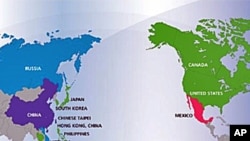
  • 21 member economies
  • Australia, Brunei Darussalam, Canada, Chile, People’s Republic of China, Hong Kong China, Indonesia, Japan, Republic of Korea, Malaysia, Mexico, New Zealand, Papua New Guinea, Peru, the Philippines, Russia, Singapore, Chinese Taipei, Thailand, the United States, Vietnam
  • 40 percent of world population
  • 55 percent of global gross domestic product
  • 43 percent of world trade


1991: China, Hong Kong and Taipei join APEC.

1993: President Bill Clinton begins practice of annual APEC leaders economic summit.
Mexico and Papua New Guinea join.

1994: At meeting in Bogor, Indonesia, APEC sets the goal of “free and open trade and investment” for developed nations in the Asia-Pacific region by 2010, and 2020 for developing nations.
Chile joins.

1998: Peru, Russia and Vietnam join.

2001: APEC issues its first counter-terrorism statement, which broadens its focus beyond economics and trade.

2003: In addition to pledging its support for the Doha round of world trade talks, APEC leaders pledge to work to dismantle terrorist groups and form an action plan on fighting the disease SARS and other health issues.

2005: APEC leaders assess progress on Bogor goals and determine the group is halfway to meeting its targets.

2007: For the first time, APEC leaders issue a declaration on climate change, energy security and clean development, which includes a program to address those issues.

2010: APEC leaders pledged to work toward realizing a Free Trade Area of the Asia Pacific, known as FTAAP. And they endorsed the APEC Growth Strategy, aimed at producing balanced, inclusive, sustainable, innovative and secure growth.

You May Like

Pakistan Reiterates Opposition to US Drone Strikes

Day earlier US President Barack Obama justified 'constrained' drone usage to save lives More

Study Identifies Risks of Human Spread of H7N9 Bird Flu

Study suggest that international measures to contain the H7N9 influenza, in the event of severe outbreak, will need to be targeted in Asia More

Violence Continues in Conakry Over Upcoming Elections

Opposition has called for boycott of elections More

Video Syria's Civil War Fuels Violence in Iraq

Analysts say al-Qaida-linked militants are flowing back and forth from both countries More

Video Star Trek Influence Lives Long and Prospers

As new movie thrills, many are once again discussing the iconic franchise's influence on society, science and technology More

OECD: Developing Green Cities Key to Sustainable Future

OECD suggests strategies to mitigate rapid growth, industrialization in urban centers, which produce about two-thirds of greenhouse gas emissions More

This forum has been closed.
Comments
     
There are no comments in this forum. Be first and add one

Featured Videos

Your JavaScript is turned off or you have an old version of Adobe's Flash Player. Get the latest Flash player.
Video

Video Volunteers Help Revive LA's Concrete River

The Los Angeles River is a concrete drainage channel through much of its 80-kilometer length. It channels waste-water from storm drains and has become a receptacle for much of the city's trash. But as Mike O'Sullivan reports, the river is slowly being restored with the help of volunteers, who take part in an annual clean-up.