News / Middle East

Arab League Demands Change in Syria

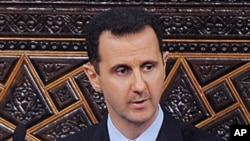
Syrian President Bashar al-Assad, addresses the Parliament, in Damascus, Syria, March 30, 2011 (file photo)
TEXT SIZE - +

The Arab League has called for "immediate change" in Syria, urging President Bashar al-Assad to end the government's violent crackdown on dissent and launch a comprehensive national dialogue.

Arab foreign ministers meeting in Cairo Tuesday demanded that Syrian authorities implement measures agreed upon during a visit to Damascus last week by the league's secretary-general.

Qatar's foreign minister Hamad bin Jassim al-Thani, who chaired the meeting, said the the current situation remains critical and that Syria must stop what he called its "killing machine."

Also Tuesday, Turkey's prime minister told the Egyptian newspaper Al-Shorouk that he fears the crisis in Syria could descend into a sectarian civil war between the Alawites and the Sunnis.

Syria's ruling elite belong to the minority Alawite sect - an offshoot of Shi'ite Islam - while most of the country's citizens are Sunni Muslim.

In separate comments before several thousand people in Cairo, Erdogan said civilian deaths have increased in Syria, but reforms have not followed. He said that neither the Syrian people nor the Turkish government believe anymore in  Assad.

Earlier Tuesday, activists said Syrian security forces carried out sweeping arrests and raids in areas outside the capital, Damascus, and in a string of cities including Daraa, Latakia and Banias.

Demonstrators also burned Russian flags in the flashpoint cities of Homs and Daraa to protest Moscow's support for  Assad. Both Russia and China oppose a draft U.N. Security Council resolution backed by European nations and the U.S. that would impose an arms embargo and other sanctions on Syria.

The United Nations estimates that 2,600 people have been killed in Syria's six-month-long uprising.

An aide to Assad disputed the U.N. figures Monday, saying that 1,400 have died. A Syrian government spokesman said the casualties have been evenly split between government forces and opposition activists.

Follow our Middle East reports on Twitter
and discuss them on our Facebook page.

You May Like

Experts Weigh In on Challenges of Closing Guantanamo Prison

Former chief military prosecutor at Guantanamo delivers petition to White House with more than 370,000 signatures, demanding facility be closed down immediately More

Karzai to Discuss Enhancing Defense Ties with India

Afghanistan looking for more military aid as it prepares for withdrawal of NATO forces by next year More

India, China Pledge to Overcome Border Tensions

Indian prime minister and Chinese premier attempt to move past tense standoff in the Himalayas during Delhi talks More

Burmese President Opens US Visit with VOA Town Hall Meeting

Ahead of his meeting with President Obama Monday, Thein Sein answered questions on human rights and economic development in his country More

This forum has been closed.
Comments
     
There are no comments in this forum. Be first and add one

Featured Videos

Your JavaScript is turned off or you have an old version of Adobe's Flash Player. Get the latest Flash player.
Video

Video US Oil Surge Could Impact Mideast Geopolitics

The United States will account for a third of new oil supplies over the next five years, and will become energy self-sufficient in 20 years, according to a new report by the Paris-based International Energy Agency (IEA). Although U.S. oil imports from Arab Gulf countries increased last year, analysts predict the U.S. will lose its dependence on Middle East imports, which is expected to have a huge impact on international relations and the balance of power. VOA's Henry Ridgewell reports.