


For decades, Washington has relied on friendly Arab governments to manage the Arab-Israeli conflict without taking Arab public opinion into consideration. But now, with popular uprisings sweeping through the region, U.S. policymakers are looking at other ways Washington can maintain its influence. Policy makers and regional experts say one way Washington can do that is by renewing its efforts to promote peace between Israelis and Palestinians.
As a wave of uprisings sweeps through much of the Arab world, one aspect of the region has not changed at all - the deadlock in Israeli-Palestinian peace negotiations.
And as Palestinians in the Gaza Strip launch rocket attacks into Israel and Israel expands settlements on captured land, U.S. Secretary of State Hillary Clinton says the situation is becoming dangerous.
"The status quo between Palestinians and Israelis is no more sustainable than the political systems that have crumbled in recent months," said Hillary Clinton. "Neither Israel’s future as a Jewish democratic state, nor the legitimate aspirations of Palestinians can be secured without a negotiated two-state solution."
Former U.S. National Security Advisor Zbigniew Brzezinski says it is time for the Obama administration to take a decisive role in promoting Israeli-Palestinian peace.
"The mood in the region is changing," said Zbigniew Brzezinski. "The prospects of Israel becoming an accepted part of the Middle East are waning and I think it behooves the U.S. to step forward with a generalized framework of what the peace has to be."
Brzezinski argues that Washington needs to move quickly before the Palestinian Authority asks the U.N. General Assembly in September to recognize an independent Palestinian state based on the borders before the 1967 Middle East war.
That possibility also worries U.S. Senator John Kerry, chairman of the Senate Foreign Relations Committee. He says the Washington should get ahead of such an appeal to the U.N. General Assembly, which he argues could complicate the already-stalled peace efforts:
"I’m not sure it will in fact advance the process. It could even force entrenchment - change some politics in a dangerous way," said Senator Kerry. "So I hope a diplomatic initiative can in fact preclude unintended consequences."
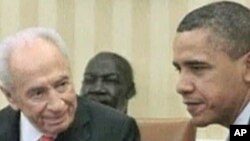
After his meeting this month at the White House with Israeli President Shimon Peres, President Obama spoke of the urgency of reaching a negotiated peace agreement in the Middle East.
"With the winds of change blowing through the Arab world it is more urgent than ever that we try to seize the opportunity to create a peaceful solution between the Palestinians and the Israelis," said President Obama.
Shibley Telhami is a professor of Peace and Development at the University of Maryland. He says successful U.S.-sponsored talks between the Israelis and Palestinians could also help Washington establish good relations with the new governments emerging in the region.
"It is very difficult for the U.S. to establish healthy relations with the emerging democracies in the Arab world as long as there is no movement toward peace between Israel and the Palestinians," said Professor Telhami.
U.S. policy seeks a two-state solution to the dispute, with independent Israeli and Palestinian nations living side-by-side in harmony. Regional experts say the time is ripe for a renewed push in that direction.