



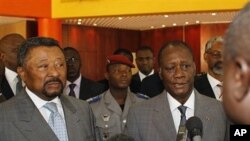
Several African heads of state are meeting in Addis Ababa (Wednesday and Thursday) to consider responses to two of the continent’s most vexing challenges, Ivory Coast and Libya. The organization’s credibility, and a chunk of its financing, are on the line.
Alassane Ouattara attends AU meeting
Internationally-recognized President Alassane Ouattara is attending; the defiant incumbent Laurent Gbagbo is absent as the African Union high-level panel on Ivory Coast holds two days of closed-door talks in the Ethiopian capital.
The panel, including five African presidents, is struggling to settle Ivory Coast’s leadership dispute against a backdrop of political violence that has claimed nearly 400 lives since December. Gbagbo’s snub in staying away is a measure of the challenge African leaders face in persuading one of their own to leave office when his time is up.
Following the panel’s deliberations Thursday evening, the AU Peace and Security Council, or PSC, will hold an extraordinary heads-of-state level meeting. The agenda will include Ivory Coast, as well as one of the most glaring examples of the continental body’s lack of commitment to democratic values, Libya.
Scholars and AU watchers say this is a defining moment for the organization.
AU credibility is a bit on the line, says expert
Laura Seay, an Africa specialist at Morehouse College in Georgia said the Peace and Security Council, whose other leaders include Zimbabwe’s Robert Mugabe and the current AU chairman, Equatorial Guinea’s Teodoro Obiang Nguema may be hesitant to take tough action against autocrats and dictators.
"I think the AU credibility is a bit on the line," said Seay. "Whether they are going to be able to formulate effective and coherent responses, and saying that violence against civilians is unacceptable to the African Union. That’s going to make a big difference on whether they have credibility not only on the international scene, but also with their own people."
Libya - a special challenge
The Libyan case presents a special challenge, since Moammar Gadhafi has used his country’s vast oil wealth to become one of the AU’s most influential figures. Libya, along with north African states Egypt and Algeria, are among five AU nations that contribute nearly two thirds of the membership dues in the 53-member organization.
Delphine Lecoutre, a researcher with the French Center for Ethiopian Studies, points to a weak statement issued last month as an example of the Peace and Security Council’s timidity in facing up to the behavior of its leaders.
"There was a Peace and Security Council meeting on Libya, which resulted in
a cosmetic communiqué hardly condemning the violence in Libya and putting it
in a [clever] way, loss of human life and destruction of property, but nothing regarding the political situation in the country," said Lecoutre. "It is difficult for the AU to deal with that case."
Lecoutre points out that until recently, when protests erupted in Tunisia, Egypt and Libya, no North African country had ever been the subject of a Peace and Security Council meeting. In 259 meetings over seven years, the body had dealt only with crises in sub-Saharan Africa.
"It is an opportunity for sub-Saharan countries to tell, 'Yes, you in the north are also part of this continent, because we from the southern part, we can talk about your issues and have an opinion about it,'" she said.
African leaders would welcome Gadhafi's departure
Africa specialist Laura Seay says many African leaders are quietly fed up with Moammar Gadhafi’s antics, and would welcome his departure.
"Some parts of Africa will change very little without Gadhafi," said Seay. "Several leaders, Zuma, Museveni and Goodluck Jonathan will be relieved to see him go."
Western diplomats and AU observers are watching with interest to see how Africa responds to the hard questions posed by Ivory Coast and Libya.
A senior diplomat, who asked for anonymity because he is not authorized to speak publicly, said the international community is looking for an unequivocal statement declaring Alassane Ouattara the winner of Ivory Coast’s presidential election. He said most western governments see no merit in settling Ivory Coast’s leadership question through a power-sharing agreement, as has been tried with limited success in Zimbabwe and Kenya.
The diplomat also said the west is looking for a more determined statement on Libya. He said anything less than suspension of Libya from the organization and possibly endorsement of a no-fly zone would be viewed as a stalling tactic.
But AU officials, speaking privately, said those were unlikely outcomes of these two days of meetings.