



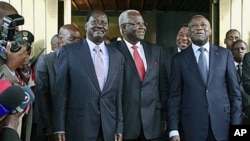
African leaders are in Abidjan for more talks with Ivory Coast's rival presidents. The country's political crisis has sent thousands of refugees into Liberia. Leaders met with defiant Ivory Coast President Laurent Gbagbo Monday, offering him an amnesty deal on condition he cedes power to rival Alassane Ouattara.
The African Union and the Economic Community of West African States have recognized former prime minister Alassane Ouattara as the newly-elected president of Ivory Coast. So the focus of the groups' joint mission to Abidjan is the man who stands in Ouattara's way - incumbent President Laurent Gbagbo.
Gbagbo says he intends to remain in power and accuses foreign governments of plotting a coup against him. Dim prospects for resolving the dispute are evident in the two sides failing to agree even on what their talks are about.
West African leaders say they are in Abidjan to press their demands that Gbagbo step down. A spokesman for Sierra Leonean President Ernest Bai Koroma, who is among the heads of state representing the West African alliance, said Gbagbo's exit is non-negotiable.
Gbagbo's aides say this meeting is all about negotiation. Ambassador Yao Gnamien, a special advisor to Gbagbo, said, "They are not coming to negotiate the departure of President Gbagbo. They are coming to Cote D'Ivoire just for a process of negotiations so that we can find a peaceful solution to the crisis."
Nigerian President Goodluck Jonathan said West African leaders will decide what to do next, following Monday's talks that also include the African Union mediator to the crisis, Kenyan Prime Minister Raila Odinga.
The West African alliance said it is considering military force to remove Gbagbo, but he is still backed by Ivory Coast's military, so a battle for control of Abidjan would be costly. Gbagbo said Ouattara should not expect foreign troops to help him and is calling for the departure of U.N. peacekeepers, who are guarding Ouattara's hotel.
Ouattara said Gbagbo militants are killing his supporters, and he wants the International Criminal Court to investigate. The United Nations estimates that more than 170 people have been killed in post-election violence.
The crisis has sent more than 20,000 Ivorian refugees into Liberia.
Malek Triki works for the World Food Program in West Africa. He said, "Many of them have come without any food, without any assets at all, and those who have some assets like goats, for example, they would sell them below market price just to be able to buy food and water. And some of them had during the first few days, had even to go back to Ivory Coast in search of food and water."
Relief officials expect as many as 450,000 people may be internally displaced and 150,000 people may eventually seek refuge in Liberia, Guinea, Mali, Burkina Faso, and Ghana.