



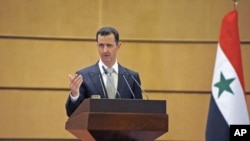
With Russia and China blocking a U.N. resolution condemning the crackdown on protests in Syria, the prospects for a quick end to the conflict seem bleak. President Bashar al-Assad can also rely on support from some other key players in the region. Our correspondent reports from the Lebanese capital, Beirut, on some complex histories and alliances in the Middle East that are shaping the response to Syria's uprising.
Syrian protesters on the streets of Damascus send their message to the United Nations, burning the Iranian, Russian and Chinese flags - all allies of the Syrian government.
The uprising is proving long and brutal. Analysts say the Syrian government has learned lessons from across the Arab world.
Analyst Paul Salem directs of the Carnegie Middle East Center.
“The regime in Syria has calibrated, has learned from the Libyan experience and has calibrated its response to be brutal but not flamboyantly so; and not to speak of it openly," said Salem. "To carry a big stick but speak softly ... they looked at countries like Egypt which had made compromises with the opposition ... and they concluded that if you compromise first, you will end up losing everything second.”
There are history lessons too in neighboring Lebanon, which fought a civil war in the 1970s and 80s.
Like Lebanon, Syria is made up of a mosaic of different religions - Sunnis and Shias, Alawites, which includes President Bashar al-Assad and much of the ruling class, along with Christians and Druze.
Beirut, now home to some of Syria’s exiled opposition, still bears the scars of that brutal conflict.
It is a war that reverberates in Syria today, says Salem.
“They have used the lessons in the reverse way," he said. "The regime is effectively threatening the Syrian people that if they get rid of the regime they will have a civil war on their hands.”
Looking east, Syria can count on Iran as its main ally. There, President Mahmoud Ahmedinejad has repeatedly berated Arab countries for pressuring Syria to end the crackdown.
He says one of the bitter and ridiculous scenarios is that in the region Arab leaders who do not have any concept of election and freedom in their culture, have gathered and want to issue freedom and democracy decrees for Syria.
With Syria’s President Assad enjoying some regional support, it will be difficult for the international community to isolate Damascus. Russia and China have also made it clear they will not support regime change through the United Nations.
Only violence on an even greater scale could prompt foreign intervention, says analyst Paul Salem.
“If something happens that is of a dramatic nature and if the Western press gets hold of it and it impacts public opinion, at the end of the day politicians are politicians and they have to respond to what the mood of the public is," said Salem. "This is effectively what happened largely in Libya, it is what happened eventually in Kosovo.”
For now, analysts say international divisions mean there is little hope of a quick solution to Syria’s conflict.
| Join the conversation on our social journalism site - Middle East Voices. Follow our Middle East reports on Twitter and discuss them on our Facebook page. |