


News / Asia

11 Militants Killed in Clashes with Pakistani Forces

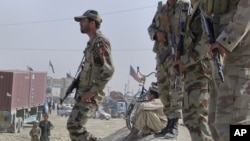
Paramilitary soldiers stand guard along a road where tribesmen gathered to protest against an alleged firing incident in Chaman, along the Afghan border June 17, 2011.
TEXT SIZE - +

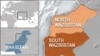
Government officials say Pakistani security forces have killed at least 11 militants during clashes in the country's northwest tribal region.

Friday's fighting in the Mamund area of the Bajaur tribal area also killed a local tribesman.

Security forces launched a search operation in the region one day after hundreds of  militants reportedly crossed the border from Afghanistan and attacked a village in Bajaur.  Five civilians were killed in Thursday's cross-border attack.

Pakistani forces have carried out a number of military operations against Taliban and al-Qaida-linked militants in Bajaur.

In Pakistan's southwest Friday, local tribesmen briefly blocked NATO supplies and other traffic on a highway near the Chaman border crossing in Baluchistan province.  

Officials say the tribesmen were protesting an incident the day before, in which Afghan forces fired on tribesmen at the border, wounding eight people.

Pakistani officials assured the tribesmen that their grievance would be brought up at the next meeting with Afghan and NATO troops.

Separately on Friday, the Pakistani military released a statement refuting media reports that intelligence officials may have tipped off terrorists about a raid on bomb-making factories.  The military called the assertion "false and malicious."

The New York Times reported last week that U.S. intelligence officials have twice provided information to Pakistan about the specific locations of insurgent bomb-making factories, only to find the sites abandoned before Pakistani troops arrived.

The Pakistani military said Friday that security forces launched operations on four compounds suspected of being used to make bombs.  Two were found to be factories and destroyed.  The military says information on the other two compounds proved to be incorrect.

Some information for this report provided by AP.
You May Like

India, China Pledge to Overcome Border Tensions

Indian prime minister and Chinese premier attempt to move past tense standoff in the Himalayas during Delhi talks More

Burmese President Opens US Visit with VOA Town Hall Meeting

Ahead of his meeting with President Obama Monday, Thein Sein answered questions on human rights and economic development in his country More

Video Washington Week: Focus on Burma, US Government Scandals

President Thein Sein visits the White House on Monday, Congressional probes of multiple scandals are continuing More

This forum has been closed.
Comments
     
There are no comments in this forum. Be first and add one

Featured Videos

Your JavaScript is turned off or you have an old version of Adobe's Flash Player. Get the latest Flash player.
Video

Video Boston Bomber Spent 6 Months in Russia’s Most Violent Republic

The news of the Boston Marathon bombings circled the globe, and resonated here in Dagestan, a majority Muslim republic in Russia, on the shores of the Caspian Sea. Last year, Tamerlan Tsarnaev, the older of two brothers suspected of the bombings and a long-time Boston resident, returned to Dagestan, where he had lived for a year during his youth. Dagestan was the land of his maternal ancestors. But in the last two years, this republic of 3 million people has gained notoriety as the region with the highest level of political and religious violence in all of Russia. VOA's James Brooke reports from Makhachkala, Russia.