



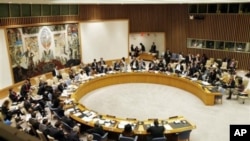
Growing acrimony among the permanent five members of the U.N. Security Council is jeopardizing action on serious issues including the council's ability to send a strong signal on the situation in Syria. From the United Nations, Margaret Besheer reports 2011 has been a difficult year for the 15-member council and tensions among the permanent five could make consensus-building in 2012 a challenge.
The different political ideologies of the permanent five members - Britain, China, France, Russia and the United States - have always made for an interesting dynamic on the U.N. Security Council. But this year, relations among the five have frayed over authorization of the NATO mission to protect Libyan citizens and a difference of opinion about events in Syria where the U.N. says more than 5,000 people have died during a government crackdown on political dissenters.
The divisions among the so-called P5 became even clearer this week, when the Russian, American and French ambassadors took to the microphones after a meeting on Libya Thursday.
The Russian Ambassador demanded an independent investigation into the possibility that NATO bombings caused the deaths of some Libyan civilians. His American and French counterparts said he was seeking only to divert attention from events in Syria, an ally of Russia.
U.S. Ambassador Susan Rice told reporters that NATO's actions saved tens of thousands of Libyan lives - an accomplishment she said that should be celebrated - and she chided her Russian counterpart.
"If the Libyans want to work with NATO to investigate any concerns they have, we are more than willing to do that," said Rice. "I think it is notable that we have not heard that call from the Libyan government. So let us see this for what it is - it is duplicative, it is redundant, it is superfluous, and it is a stunt. And if others want to go along with it they can, but I did not hear a majority of the members of the council indicate they think this is necessary."
Her French counterpart, Gérard Araud, noted that there are already two on-going investigations into how the Libyan crisis played out - one is being conducted by the U.N. Human Rights Council and the other by the International Criminal Court - and he brought the conversation back to Syria.
"There are two on-going investigations, so why ask for a third one while we do not have any investigation committee in Syria when in the last 3 to 4 days more than 250 people have been killed," noted Araud. "This is a bit strange. So we can say that we have seen today one more ploy."
On Friday, Russian Ambassador Vitaly Churkin, who is president of the council this month, expressed his frustration with his colleagues at a hastily called news conference. He said the growing acrimony among the P5 is affecting the council's work.
"I am worried. It has been my fifth and toughest presidency. I think that as a council we are not moving in a good direction," Churkin said. "There is a lot of nervousness, a lot of expectations that things are going to be done my way or no other way. That what I need to have I must have now, no objections entertained or no other views are entertained. I don't think this is a good way to work in the council. I think that if this trend were to continue it might seriously hurt the ability of the Security Council to work."
He said he does not know how to reverse this negative trend and said that even on the smallest issues there have been disagreements.
Some council members say the Libya resolution has had a lasting impact on how some council members approach matters such as Syria and Yemen, making them fearful of directly or indirectly authorizing outside intervention. Other diplomats say it is just a convenient excuse to do nothing.
After Friday's press conference, Ambassador Rice tweeted a friendly holiday message to Ambassador Churkin, but her spokesman tweeted a photo of a storybook character who steals Christmas with the face of the Russian diplomat super-imposed over the character's face.
As 2011 ends on a rocky note, it remains to be seen how the five powers will work together in the new year. Meanwhile, the council's draft resolution on Syria hangs in the balance as negotiations continue in this tense atmosphere.
| Join the conversation on our social journalism site - Middle East Voices. Follow our Middle East reports on Twitter and discuss them on our Facebook page. |