



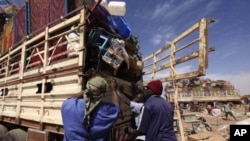
Hundreds of southerners are stranded in camps near the edge of Khartoum. They’ve been stuck there for more than three weeks waiting for the Government of Southern Sudan to provide them with transport to go back home ahead of the independence referendum next week.
Those stranded near the town of Mayo, 25 km south of Khartoum, say that they don't have money to return home on their own, and they need the government to step in.
"Our situation is very bad, we have money problem, we need to the government of south Sudan to give money for us and to take us to travel to Wau, please we need any country to come and help us," says Joseph, a southerner trying to get back to his home in Wau.
Tens of thousands of southerners have already returned to their ancestral homelands in anticipation of the referendum on independence, many through a government program that aims to provide free transport to 1.5 million southerners living in the north.
Many southerners say they are leaving because of uncertainty about their citizenship rights or because of possible retaliations against them in the north after should the south decide to secede in the referendum. Some arrived back with the hope to register for the referendum, and some to come back home to a place where they feel more safe than in the North.
“In the North, there is a lot of discrimination. Whenever a northerner comes in the night and finds you having property, he could simply deprive you of having them,” explains Santino Aleu, a recent returnee to the south. “That is why I used my own money and paid it as busfare and came home. And I caught up with people registering themselves for referendum’s votes, and I am now registered. Even though we are faced with some tough conditions like lack of food here, it is our home. There is no way we can leave our home again.”
Northern Bahr el Gazal state in southern Sudan is one of the states that has hired buses to voluntarily bring home some of its people who were displaced to the north during the war.
Those who have returned have been reunified with some of their family members, and most are being allocated lands. The state government, with United Nations support, has also provided food relief, clean water, shelter, and land to help meet their basic needs, but some say it is not enough.
Amiir Akok, a returnee woman, says although she is happy being home, she still faces a lack of food, water and other needs.
“We are glad for having arrived back, because the life in the North was not safe,” she says, adding, “We have come with little children, they are with us, they are suffering from hunger, and lack of health services.”
It’s not the first time the state has organized to bring its former residents back home. It has been bringing people back since 2007, but many return to the north and resume working petty jobs due to Northern Bahr el Ghazal’s lack of educational and health services, and lack of employment opportunities.
One recent returnee, Piol Bol Akok urges his fellow returnees to endure the challenges this time around and stay in the south.
“What I also like to tell my people who came with me is that if someone misses better education, and healthcare, I am appealing to all of them to stay here and should not go back to North,” he says.
Piol Bol Akok also appeals to the state government to fulfill its promise to bring home those who want to return.
“What I like the state governments do is to implement what they said, that they would bring back everyone in the northern camp,” he says. “We have people who are still in camps such as in Darfur. We want the government to increase the number of buses and send them and bring back them here.
Cezar Andrea is one of those who is stranded in the north. He wants to get back to his hometown of Wau, but says he is losing hope that the government will come to his aid.
"We've been here for 24 days, we should be in the south long time ago,” he says. “I don't know when we will go. They are telling us every day, ‘tomorrow you will leave,’ but if you come tomorrow you will find us here.”
-
Special Report: Sudan in Focus
Full coverage of the Comprehensive Peace Agreement and southern Sudan's referendum on independence