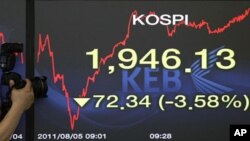
Asia continued to participate in the major global equity markets sell-off Friday. Fears of another drop into recession for the world economy spooked investors across the region. Japan’s benchmark Nikkei closed at its lowest level in five months, after falling nearly 3.75 of a percent in the latest session.
Stock prices also tumbled across the board from Mumbai to Hong Kong. Overall the major regional indexes are off about 10 percent from the peaks reached during May.
South Korea’s key KOSPI index dropped 3.7 percent to finish at its lowest mark in 20 months.
Kim Ji-whan, head of research at Hana Daetoo Securities in Seoul notes the South Korean market is undervalued and the country's economy is very strong compared to other advanced nations.
"But the problem is that most of the Korean big companies listed in the stock market are mostly export driven," said Kim. "That means they are heavily dependent on demand from the global economy. And, also, there are worries that the U.S. dollar could get weaker. And that means the Korean Won will get stronger. Korean exporters will suffer."
Foreign exchange markets were calmer than they were Thursday with anticipation of more intervention by Japan’s Finance Ministry. That kept the US dollar stabilized around 79 yen.
With economic vital signs rapidly growing weaker on both sides of the Atlantic, market researcher Kim does not expect an immediate recovery for equities here in Asia.
"We have to wait, at least, one or two months, before we see any economic indicators getting better," he said. "Until then most of the Asian markets, of course including Korea, will suffer I guess."
South Korea's Ministry of Strategy and Finance confirms it convened an emergency meeting Friday morning as stocks plunged in Seoul and across Asia. The internal meeting was headed by vice minister Lim Jong-ryong. A ministry spokesman says officials will cooperate with related government agencies in an attempt to calm fears that are permeating the equity markets.
With China trying to slow its dynamic economy, the world’s second largest, analysts say there is a lack of a significant anchor for global growth.
That scenario has sent investors fleeing to the few investment instruments seen as still reliable should there be a huge worldwide meltdown.
Market players say there is now caution about the traditional safe haven of gold bullion because many investors are now cashing in on the commodity's already steep rise this year. They say that may force gold prices lower early next week.
Bonds issued by the U.S. Treasury are in demand, despite rates on some of the inflation-protected notes dipping below zero, meaning worried investors are essentially paying the United States government to hold their money.
Asian Markets Continue Global Slump