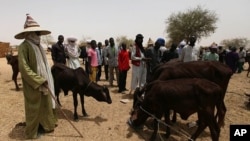
Poor rains have brought crop failure to parts of Niger, but aid agencies say a closer watch and better reporting on conditions have led to improved distribution of relief supplies.
The United Nations says some farmers in Niger are facing complete crop failure.
Denise Brown, the Niger country director for the U.N. World Food Program, says Niger's government and U.N. agencies are concerned about food security in areas west of the city of Agadez where there are poor harvests due to light rains and heavy infestations of pests. She says some families are still recovering from the last drought as they see another one coming.
In general, Brown says aid agencies are expecting a poor harvest in Niger, with some regions where families and villages will have no harvest at all.
Niger is chronically food insecure with a growing population overtaxing agriculture output in this vast Sahelian country.
But relief officials say better reporting of drought conditions since a food crisis in 2005 is improving the response of aid agencies and Niger's new civilian government.
Grant Leaity directs emergency operations for the United Nations Children's Fund in West and Central Africa.
“We clearly saw a very different level and quality of response in Niger last year as compared to 2005," said Leaity. "It took years to actually build up and improve the system. In Niger we have got weekly reporting of nutrition cases. There are other countries where on paper it is monthly, but in reality it is often two or four-weeks late or sometimes the data just doesn't come.”
Leaity says timely reporting allows the government and relief groups to better coordinate their response.
“That is an example of a very concrete surveillance system," said Leaity."You are actually tracking the level of impact on a week-by-week basis. And then you can see when the acceleration kicks in. And that helps you to take the right decisions at the right time.”
There is a food-for-work program to help keep people fed between the harvests and a free distribution of food or food vouchers in vulnerable communities.
The WFP's Brown says her agency is working to reinforce activities and boost supplies on the ground over the next six months.Better reporting helps to more quickly identify vulnerable communities, where Brown says farmers are being encouraged to use public water supplies to grow crops out of season instead of waiting for the next rains.
Better Drought Surveillance Improves Aid Delivery in Niger