



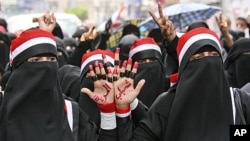
Hundreds of thousands of Yemenis have rallied in major cities throughout the country, demanding President Ali Abdullah Saleh step down and calling for a transitional council that excludes members of the current government.
In the capital, Sana'a, a huge crowd swelled Tuesday outside the home of Yemen's acting leader, Vice President Abd al-Rab Mansur Hadi - a day after Yemen's political opposition held talks with him on a possible transition plan.
Similar demonstrations were held in several other cities, Hadramawt, Hodeida, Ibb, Damar and Saada.
Mr. Saleh transferred power to his deputy after traveling to Saudi Arabia to seek medical treatment for wounds suffered in an attack on his presidential compound earlier this month. Several high-ranking Yemeni officials wounded in the attack are also being treated in Riyadh.
Yemen's state news agency said Mr. Saleh told Saudi King Abdullah by telephone Tuesday that his health is "constantly improving."
Meanwhile, the Gulf Cooperation Council met in Riyadh Tuesday to discuss how to resurrect its initiative aimed at resolving Yemen's political crisis.
The United States and Saudi Arabia are attempting to persuade Yemen's ruling party to adopt the GCC deal that would end Mr. Saleh's rule, create a unity government and conduct elections within two months. The group's efforts to help resolve the unrest stalled after President Saleh refused to sign a proposal which calls for him to eventually leave office.
In another development, Yemeni security sources say a bomb killed an army officer in a region near the southern port of Aden. Officials said the blast tore through the car of Colonel Muti'a al-Sayani while he was driving Monday.
In Washington, the State Department's counterterrorism coordinator said the U.S. is concerned Yemen's ongoing unrest could fuel connections between al-Qaida-linked militants there and al-Shabab insurgents in Somalia.
Daniel Benjamin said the United States is still cooperating with Yemen in the fight against al-Qaida despite the Gulf nation's political crisis and Mr. Saleh's absence.
Some information for this report was provided by AFP, AP and Reuters.