



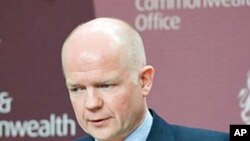
Britain's Foreign Secretary William Hague says international powers should consider arming Libyan rebels. He says it would be a "nightmare" if Libyan leader Moammar Gadhafi stays in power.
British Foreign Secretary William Hague says a no-fly zone remains a viable way to topple Libyan leader Moammar Gadhafi.
"Clearly a no-fly zone is one of the leading propositions,” Hague said. “It isn't the answer to everything, but it has been called for by the Arab League. And it is something which the international community now must consider."
Speaking Monday on the BBC, Hague said Libyans will face a "nightmare" if Gadhafi regains control of the country.
Middle East expert David Hartwell is from the Britain-based military analysis group IHS Jane’s. He says the clock is ticking on a no-fly zone, and it is not clear that the tactic would now be effective.
"There will be questions being asked about how effective it will be in stopping Gadhafi's troops, which seem to be making very good gains on the ground,” said Hartwell. “In the past few days, there have been reports that air sorties have been scaled back somewhat, which may be part of a Gadhafi strategy to sort of suggest that a no-fly zone would be useless."
Foreign ministers, including Hague and U.S. Secretary of State Hillary Clinton, are due to meet Monday for a meeting in Paris of the Group of Eight leading world economies.
France holds the year-long rotating presidency of the G8. It has been at the forefront of calls to take quick action on Libya.
Hartwell says Britain and France have gone out on a limb by pushing for fast action against Gadhafi.
Russia and China, he says, have expressed reservations about the plan, and the United States is also hesitant.
He says there is not a great amount of domestic pressure in the United States for intervention in Libya.
"The American reticence I don't think is particularly hard to understand if you look at it through the lens of the American experience in Iraq,” he added. “And clearly Iraq is looming very large in the American conscience on this."
And he says many international observers remain unconvinced that the opposition in Libya is a credible alternative to Gadhafi.
"I think there are reservations within the international community about how stable and how unified and how qualified the opposition forces are to present themselves as a unified government after any event that Gadhafi fails," Hartwell said.
In his interview with the BBC on Monday, Foreign Secretary Hague said arming Libya’s opposition could be an option. France has offered diplomatic recognition to the opposition.