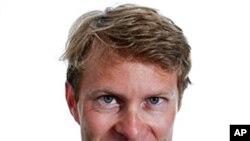
Russia has expelled a British journalist, believed to be the first expulsion of a British staff journalist since the Cold War. The action comes after The Guardian newspaper reported that Russia had become a "virtual mafia state" under Vladimir Putin, a phrase that came from the Wikileaks cables.
Until last weekend, Luke Harding was the Moscow correspondent for the London newspaper, The Guardian. When he flew to Moscow on Saturday, and handed over his passport at the airport, the woman behind the counter looked surprised.
"My passport was taken away and then, very quickly, another 7 or 8 minutes, a young man from the Federal border service came out and said, ‘For you the Russian Federation is closed'," Harding said.
Harding had a valid visa and accreditation. The authorities said that did not guarantee him entry into Russia and put him into a cell with 4 Tajiks, a Kyrgyz man and a woman from Congo who had been there a week. All were awaiting deportation. Harding says he was in the cell about 15 minutes when his luggage was brought to him.
"Half an hour after that I was led through security, back on to the plane that I’d just arrived in and finally, once someone had signed for me on the plane I got my passport back with a big blue stamp over the visa with the words annulled, and that was it, that was the end of my four year career as a reporter in Moscow," Harding added.
Harding had been warned by Russian authorities they didn’t like his reporting.
"There are certain stories you don’t write about, you don’t write about Vladimir Putin’s alleged personal fortune hidden overseas, you don’t write about the activities of the intelligence services in Russia and you’re not really supposed to write about the really disastrously counterproductive ant-terrorism campaign if you live in Russia’s North Caucasus where there’s a big war going on, and I kind of bust all those taboos really," he added.
But he believes it was his reports based on the U.S. Embassy cables leaked by WikiLeaks that prompted the expulsion. One report stated U.S. officials thought Russia was a "virtual mafia state" under Vladimir Putin. Harding says the cables were enlightening.
"There’s astonishing stuff in them, and basically showed that U.S. diplomats took a really dim view of Russia and basically thought it was a corrupt kleptocracy," Harding said.
He says he was just doing his job.
"I think if any decent journalist had the material, was the first person to look at the material from Russia on the cables, they would have written rather similar stories to me," he said.
Harding acknowledges his experience was mild compared to the type of danger and harassment that Russian journalists face.
“Journalists are routinely beat up in Russia and quite frequently they are murdered and the perpetrators are mysteriously never found,” said Harding.
More than 30 reporters have been killed in Russia since 1993, and about three dozen were attacked in 2010. Russia ranks 140th out of 178 countries in the Reporters Without Borders 2010 press freedom index.
The free speech organization called the expulsion "a heavy-handed attempt to get journalists to censor themselves and to prevent impartial coverage of what is happening in Russia."
The Guardian reported that Harding is believed to be the first British staff journalist to be expelled since the Cold War. Harding says it is not a positive development.
He said, "This full-blown Soviet-style expulsion hasn’t happened for a while and I think it’s well, it’s an ominous sign isn’t it?"
The Russian Foreign Ministry said Harding had broken media rules, and might be allowed back into Russia if he fixes his accreditation problems.
British Journalist Expelled from Moscow