



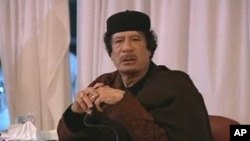
A Libyan opposition leader says coalition forces enforcing the U.N-authorized no-fly zone over Libya should capture leader Moammar Gadhafi so that he can be put on trial at the International Criminal Court (ICC) for crimes against humanity.
Hadi Shalluf, president of the Justice and Democracy Party of Libya, says the opposition is not ready to negotiate with Gadhafi because, in his words, the Libyan leader is a criminal.
“No, no negotiations with Gadhafi. Nobody can negotiate with him because he’s a criminal. He’s under investigation now by [the] ICC [International Criminal Court]. We want them [coalition forces] to capture Gadhafi live with his sons, with his family and then take him [to] trial. We will give him the right to defend himself if we capture him. If [he] decides to fight until he dies, that’s something different,” he says.
Shalluf says it has been difficult for outsiders to make phone contact with members of the Interim Governing Council in rebel-controlled Benghazi because, he says, the Libyan leader has put a bounty on the heads of the rebel leadership.

“As you know, Gadhafi offered big money to anybody who would kill them [interim leaders]. For that they are changing addresses, they’re changing their phone numbers, and then they try to be in hiding from being captured by Gadhafi troops because, as you know, Gadhafi has many mercenaries,” Shalluf says.
He says the Provisional Transitional National Council that is currently administering eastern Libya has a goal to bring genuine democracy to Libya once Gadhafi has been removed from power.
“It’s a very important question and I thank you for that because now the transitional council is just for Gadhafi to step down. Later, we have to create a national government, and then this Transitional National Government they will be asking for another commission to elaborate institutions,” he says.
Shalluf says because Gadhafi did very little to establish institutions that would make possible a smooth transition, the Libyan people will need international support as they set out to establish democratic institutions in post-Gadhafi Libya.
“Gadhafi ruled the country for 42 years and, unfortunately, there are no institutions. But, at the same time, we are inviting the United Nations and other countries to help us to make a government, to make a constitution and election,” Shalluf says.