



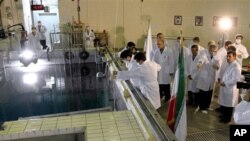
Talk of war over Iran’s nuclear program has escalated in recent weeks, and Israel and the United States have not ruled out military action to keep Tehran from producing a nuclear bomb. Despite the increasingly sharp rhetoric, all sides are expressing hope that a diplomatic solution can be found to solve the crisis.
Top officials say there is a diplomatic path to avoid a military conflict. Iranian Foreign Minister Ali Akbar Salehi says there are two alternatives - engagement or confrontation.
“The Islamic Republic of Iran, confident of the peaceful nature of its nuclear program, has always insisted on the first alternative,” Salehi said.
“There is time and space for diplomacy. But in order for that to happen Iran has to meet its international obligations,” said US Secretary of Defense Leon Panetta.
Analysts say sanctions are beginning to cripple Iran’s economy.
And recently the nation’s senior nuclear negotiator said Tehran is ready to resume talks.
“This response from the Iranian government is one we have been waiting for, and if we do proceed, it will have to be a sustained effort that can produce results,” Secretary of State Hillary Clinton said.
Talks last year in Turkey between Western nations and Iran produced no progress.
Some analysts doubt any renewed negotiations are likely to succeed. “They are simply exposed to too much scrutiny, too much press attention, too much media attention, too much political attention for either side to move very much,” said James Dobbins of the Rand Corporation.
Despite Western sanctions Iran is continuing to pursue its nuclear program, with leaders saying it will not yield to outside pressure. But the country’s supreme leader, Ayatollah Ali Khamenei, says Iran has no interest in developing an atomic bomb.
“We want to say that we are not in pursuit of nuclear weapons and we do not see power in (the possession of) nuclear weapons and we can break the dependence on nuclear weapons and God willing the nation will do this,” Khamenei said.
Israel and the United States say if diplomacy and sanctions do not work, military action remains an option. That could backfire, says Massachusetts Institute of Technology security expert Jim Walsh.
“Following an attack, Iran will definitely decide to pursue a nuclear weapons capability,” Walsh said.
Western nations have been following a two-track approach to Iran’s nuclear program, intensifying sanctions while leaving the door open for diplomatic efforts.