



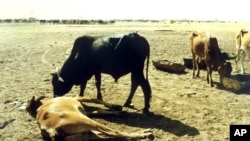
Scientists are declaring victory over a deadly animal disease that cattle herders around the world have dreaded for millennia.
Rinderpest becomes the second disease in all of human history to be successfully eradicated, after smallpox.
It played a role in the fall of Rome, the French Revolution and paved the way for the colonization of Africa, historians say. Where rinderpest struck, cattle death was swift and often total.
“If you could imagine that you are an owner of 100 animals - a milking herd - by the end of the week, you would have zero, it would go so fast through the population,” said the UN Food and Agriculture Organization's Animal Health Service Chief, Juan Lubroth.
And the effects were devastating for those who depended on cattle for their livelihoods.
"There is no possible comparison between rinderpest and other diseases,"said FAO Assistant Director-General Modibo Traoré. "Of course, when cattle die, it is about meat, it is about milk, it is about other animal production.”
Widespread devastation
When rinderpest first hit sub-Saharan Africa in the late 19th century, it killed 80 to 90 percent of the region’s cattle and triggered severe famines.
At its widest extent, in the 1920s, rinderpest stretched from northern Europe to southern Africa and east to the Philippines.
This age-old plague was finally tamed by a vaccine first developed in the 1960s. Large-scale, coordinated, village-by-village vaccination campaigns reduced the disease to a few pockets. But nomadic cattle herders in East Africa presented a particular challenge.
“Animals move from one region to another, and very often across national boundaries," said the Inter-African Bureau for Animal Resources’ Henry Wamwayi. "And therefore, transnational animal diseases can only be controlled if there is cooperation among countries.”
The FAO spearheaded a global eradication program beginning in 1994.
Rinderpest-free
The last known case was in Kenya in 2001. Last year, the country celebrated its certification as rinderpest-free.
But because wild animals also carry the disease, it took several years of intensive worldwide surveillance to be sure rinderpest was truly gone.
Today, Lubroth says, the world can finally claim victory.
“By having had a good vaccine and eradicating rinderpest, I think, from a food security point of view, this is a tremendous accomplishment,” he said.
Rinderpest becomes only the second disease besides smallpox to be found nowhere on earth but frozen away in a few laboratory vials, making the world a little safer for cattle and the people who depend on them.