



The 21st century has brought changes to all parts of the country.
In even the most remote corners of rural America, everything from high-speed internet to digital billboards are connecting folks in small towns with a way of life that's common in urban settings.
But one thing hasn't changed in many states where people still make a living raising cattle: rustlers stealing cattle. In fact, officials say, it's getting worse.

You can't get too close to Gil Nitsch's ranch house just outside Chadron, Nebraska, without one of his dogs "greeting" you.
But like many ranchers in the mostly-rural states of the American West, Nitsch has most of his cattle herd grazing on land far from his home, where there are no watchdogs.
"So, it's pretty difficult, really, to know what's going on at some of these parcels that you have cattle," he says. "Twice a year, you really have a good count, you know, when you calve, and then when you sell."
Many reasons why cattle go missing
When ranchers do their twice-a-year counts, the numbers don't always add up as they should. Some of the missing cattle have been hit by lightning or killed by predators. Others wander across property lines and mingle with neighbors' herds while a few just disappear, usually after heavy snowstorms.
But others - quite a few others - are stolen, including nearly a dozen from Gil Nitsch's herd.
The rancher recalls a phone call from Shawn Harvey, an investigator with the Nebraska Brand Commission. "And he asked me, 'Are you short any cattle?' I says, 'Not to my knowledge.' And then he says, 'Would you believe we've got 10 of your cows at Wahoo, Nebraska?'"
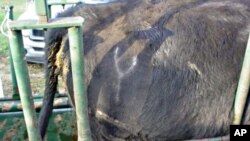
Wahoo is nearly 650 kilometers to the east of Nitsch's ranch - even further than that from his cattle herd. On a tip, a state agriculture official had checked on 10 cows that had been purchased by a sale barn there. The investigator found a "Y double bar" brand on the cattle. The stylized "Y" with two lines under it shows the animals were from Nitsch's herd.
Investigator Shawn Harvey says cattle rustling is fairly common. "Obviously, with time, it's evolved into a much higher-tech business than what it was back in the Old West," he says. "Back then, they did it horseback and drove the cattle. And nowadays, it's pretty easy for them to get wheels underneath the cattle [put them on a truck] and get them out to where they can sell them somewhere where there is no inspection."
To brand or not to brand
Brand inspections are where the system breaks down.
Harvey explains that each county has its own rules. Counties in the western two-thirds of Nebraska require all cattle to branded, while those in the east don't.
"There is no requirement in the no brand area. The only thing that's ever required, when you sell something in the no-brand area, you are to give a bill of sale. So, basically, you can take a piece of paper, write out that 'I, John Doe sold Jane Doe 10 head of cattle', you date it, you sign it. That's all that's required."
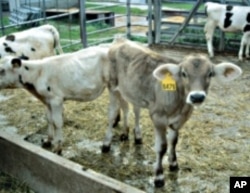
Cattle are bought and sold every Tuesday at the Livestock Auction Market in Gordon, Nebraska. It's on the west side of the state, so the cattle have to be branded.
Glen Andrews has been ranching in the area for 35 years and says the requirement just makes sense. "I think the whole state should be under branding rule because it's a form of I.D. and it's your personal signature on your cattle. I think it would help immensely to figure this out when something like cattle rustling happens."
Officials and ranchers from eastern Nebraska say they don't brand because they view the process as an inconvenience - even though their cattle operations are typically much smaller than those in the western part of the state.
Investigator Shawn Harvey says since neighboring Iowa and Kansas, as well as Oklahoma, Missouri and most eastern states don't require branding, ranchers in eastern Nebraska feel that there is little point to branding their cattle.
The good news for Gil Nitsch is that eight of his 10 rustled cows were returned, and the man who stole them was caught.
Cattle rustling was a hanging offense in the 19th century. These days, 21st century rustlers simply face up to 20 years in prison and a $20,000 fine.