



News / Africa

Charles Taylor Boycotts Trial for Second Day
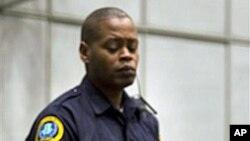
Former Liberian President Charles Taylor awaits the start of the prosecution's closing arguments during his trial at the U.N.-backed Special Court for Sierra Leone in Leidschendam, February 8, 2011.
TEXT SIZE - +

Former Liberian President Charles Taylor has boycotted his Hague-based trial for the second day in a row, forcing judges to adjourn the proceedings until Friday.  Taylor is charged with 11 counts of war crimes and crimes against humanity for arming rebels in neighboring Sierra Leone who waged a brutal civil war.  

Mr. Taylor’s no-show comes on the day his lawyers were supposed to make their closing arguments in his three-year war crimes case.  On Tuesday, Taylor’s lawyer stormed out of court, saying it was not possible to properly defend his client after judges refused to accept his written closing statement because he missed the deadline.

Mr. Taylor did not return to court after a short recess.  This morning, he notified judges that he was waiving his right to be present.  

"I will note that Mr. Taylor has opted not to come because we have not been given, for example, the medical note we have seen in the past, and accordingly I will rule pursuant to the rules that the matter will proceed." Presiding Judge Teresa Doherty stated.

Mr. Taylor’s lawyers have asked for the right to appeal the judges’ decision not to accept their final written submission.  Prosecutors on Tuesday gave a lengthy closing argument, saying Mr. Taylor is ultimately responsible for using terror to control the people and diamond wealth of neighboring Sierra Leone for his own greed and lust for power.  About 120,000 people were killed and thousands of more mutilated during the country’s 10-year civil war.

Judges adjourned the trial until Friday, when the defense is scheduled to reply to the prosecution’s closing arguments.  Prosecutors were also expected to rebut any defense arguments then, but judges canceled that part of the hearing, noting that there are no arguments for them to refute.   

You May Like

India, China Pledge to Overcome Border Tensions

Indian prime minister and Chinese premier attempt to move past tense standoff in the Himalayas during Delhi talks More

Burmese President Opens US Visit with VOA Town Hall Meeting

Ahead of his meeting with President Obama Monday, Thein Sein answered questions on human rights and economic development in his country More

Video Washington Week: Focus on Burma, US Government Scandals

President Thein Sein visits the White House on Monday, Congressional probes of multiple scandals are continuing More

This forum has been closed.
Comments
     
There are no comments in this forum. Be first and add one

Featured Videos

Your JavaScript is turned off or you have an old version of Adobe's Flash Player. Get the latest Flash player.
Video

Video Boston Bomber Spent 6 Months in Russia’s Most Violent Republic

The news of the Boston Marathon bombings circled the globe, and resonated here in Dagestan, a majority Muslim republic in Russia, on the shores of the Caspian Sea. Last year, Tamerlan Tsarnaev, the older of two brothers suspected of the bombings and a long-time Boston resident, returned to Dagestan, where he had lived for a year during his youth. Dagestan was the land of his maternal ancestors. But in the last two years, this republic of 3 million people has gained notoriety as the region with the highest level of political and religious violence in all of Russia. VOA's James Brooke reports from Makhachkala, Russia.