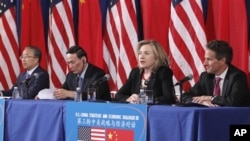


Despite few concrete results from this week’s high-level U.S.-China talks in Washington, Chinese officials indicate their government firmly supports increasing dialogue with their American counterparts.
The just-concluded U.S.-China Strategic and Economic Dialogue highlighted strong differences the two countries have on a wide range of issues, including currency reform, trade and human rights.
In Beijing, Foreign Ministry spokeswoman Jiang Yu emphasized that communication is an important part of resolving differences.
Jiang said only through dialogue can China and the United States enhance mutual understanding and "properly handle differences, problems or disputes that stand between them."
She commented on a media report this week that quotes Secretary of State Hillary Clinton as calling China’s human rights record deplorable and saying that the country will fail in its attempts to “stop history” by clamping down harshly on dissent.
Jiang was unperturbed in her response.
She suggested that the reporter who asked the question has only a partial understanding of Secretary Clinton’s remarks. She then emphasized the spirit of cooperation between China and the United States, and said most of the reports she has seen assessing the talks are generally positive.
The Chinese spokeswoman pointed to energy cooperation as one area where the two countries can work together. In 2008, the United States and China signed a 10-year agreement on energy and environment cooperation.
Jiang said one result of the first-ever strategic security component of the talks is the decision to launch a consultation on Asia Pacific affairs.
She said she thinks the Asia Pacific region is where China and the United States have, "the most converging interests."
In recent years, China has stepped up its territorial claims to disputed islands in the South and East China seas. These conflicts have prompted a regional backlash and, as a result, many of the rival claimants have drawn closer to the United States, which is the region’s dominant naval power.
China Downplays Differences With US After Last Round of Talks
- By Stephanie Ho