



News / USA

Chinese Symbols Prove Popular in US

But not everyone gets the right message

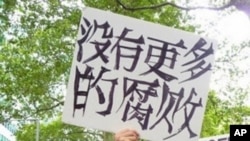
This “Occupy” protestor may have thought his sign said “No More Corruption.”  Actually, as translated, it’s closer to “There isn’t any more corruption.”
This “Occupy” protestor may have thought his sign said “No More Corruption.” Actually, as translated, it’s closer to “There isn’t any more corruption.”

Multimedia

Audio
TEXT SIZE - +
Ted Landphair

From the moment Spaniards - or Vikings, some would say - first dropped anchor and encountered the natives whom the Spanish called “Indians” because they thought they had arrived in India - the land now known as “America” has been a multicultural place.

And of course it’s much more so today. Just check out our faces and dialects and music.

Our signs are getting more multicultural, too. We see them in English, Spanish, Arabic, Chinese, and more. Well, maybe it’s Chinese.

Mandarin Chinese characters, called “Hanzi,” are hot right now. They’re a popular decoration on clothing and artwork and tattoos.
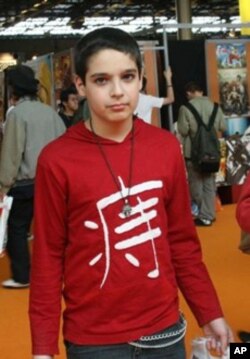
No doubt this boy or his parents thought this character translates as “samurai,” but the character actually means “hemorrhoid” in English.

Just ask Tian Tang, a 35-year-old Chinese-American engineer, who works for an Arizona company that makes electrical semiconductors. Since his graduate-school days, he has maintained a website showing that an awful lot of the Chinese characters we see across America are just plain wrong.

Some are not even Chinese at all, but pretty little ink strokes that sort of look Chinese.

One of Tang’s postings shows a colorful shirt decorated with a powerful, leaping tiger. Next to the beast are nine Chinese characters. But they translate into gibberish - words such as “unicorn” and “chicken.” Not one of the characters has anything to do with tigers, or even cats.
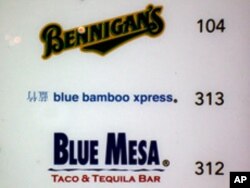
Indeed, the characters on this sign do mean “blue bamboo,” but they’re upside down.

Other Hanzi, delicately tattooed onto a woman’s back, translate as “crazy diarrhea.” Surely this wasn’t what she ordered from the tattoo artist.

So, America is a multicultural melting pot. But reading the signs doesn’t always tell you who you’re melting with.

“If people would stop making fools of themselves, my site would dry up,” Tang says.

You May Like

India, China Pledge to Overcome Border Tensions

Indian prime minister and Chinese premier attempt to move past tense standoff in the Himalayas during Delhi talks More

Burmese President Opens US Visit with VOA Town Hall Meeting

Ahead of his meeting with President Obama Monday, Thein Sein answered questions on human rights and economic development in his country More

Video Washington Week: Focus on Burma, US Government Scandals

President Thein Sein visits the White House on Monday, Congressional probes of multiple scandals are continuing More

This forum has been closed.
Comments
     
There are no comments in this forum. Be first and add one

Featured Videos

Your JavaScript is turned off or you have an old version of Adobe's Flash Player. Get the latest Flash player.
Video

Video Boston Bomber Spent 6 Months in Russia’s Most Violent Republic

The news of the Boston Marathon bombings circled the globe, and resonated here in Dagestan, a majority Muslim republic in Russia, on the shores of the Caspian Sea. Last year, Tamerlan Tsarnaev, the older of two brothers suspected of the bombings and a long-time Boston resident, returned to Dagestan, where he had lived for a year during his youth. Dagestan was the land of his maternal ancestors. But in the last two years, this republic of 3 million people has gained notoriety as the region with the highest level of political and religious violence in all of Russia. VOA's James Brooke reports from Makhachkala, Russia.