



News / Asia

Chinese Report Blames Exiled Monk for Self-Immolations

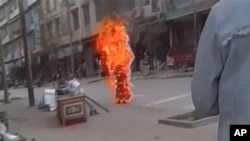
Tibetan Buddhist nun Palden Choetso sets herself ablaze in Daofu, or Tawu in Tibetan, in this still image taken from video shot November 3, 2011.
TEXT SIZE - +

A Chinese expert on Tibet has accused religious leaders close to Tibet's exiled spiritual leader, the Dalai Lama, of using extremist teachings to push Buddhist monks in China to set fire to themselves.  

Nine monks and two nuns have set themselves on fire in ethnically Tibetan parts of southwest China this year to protest religious repression. Many were from the Kirti monastery in Sichuan province.

The state-run Xinhua news agency has published an article by Beijing-based Tibetologist Hua Zi, who describes self-immolation as an extreme act of violence and terrorism.

The report quotes the head of a local Aba district religious bureau as saying a high-ranking monk from Kirti, who fled to India in 1959 with the Dalai Lama, had encouraged the desperate acts of protest. The monk has not been named.

But the exiled head Lama of the Kirti monastery, Kirti Rinpoche, told VOA's Tibetan service by phone Friday that exiled Tibetan leaders never try to create influence. He added that when Chinese officials cannot find any proof they say whatever they like.

The Dalai Lama told the BBC last week that acts of self-immolation were "courageous" but not wise because they only provoke a tougher response by the Chinese government. He denied Beijing's allegations that he encourages such acts.

In the interview, he told the British broadcaster that the Tibetans are using the desperate measure because "they know while the West has backed the Arab Spring, with China it talks with a much quieter voice."

Many Tibetans in China accuse the government of using religious repression and of eroding their culture, as the country's majority Han ethnic group increasingly moves into historically Tibetan areas.

China rejects the criticism claiming Tibetans enjoy religious freedom and the government is investing in developing their areas.

Some information for this report was provided by AFP.

You May Like

Experts Weigh In on Challenges of Closing Guantanamo Prison

Former chief military prosecutor at Guantanamo delivers petition to White House with more than 370,000 signatures, demanding facility be closed down immediately More

Karzai to Discuss Enhancing Defense Ties with India

Afghanistan looking for more military aid as it prepares for withdrawal of NATO forces by next year More

India, China Pledge to Overcome Border Tensions

Indian prime minister and Chinese premier attempt to move past tense standoff in the Himalayas during Delhi talks More

Burmese President Opens US Visit with VOA Town Hall Meeting

Ahead of his meeting with President Obama Monday, Thein Sein answered questions on human rights and economic development in his country More

This forum has been closed.
Comments
     
There are no comments in this forum. Be first and add one

Featured Videos

Your JavaScript is turned off or you have an old version of Adobe's Flash Player. Get the latest Flash player.
Video

Video US Oil Surge Could Impact Mideast Geopolitics

The United States will account for a third of new oil supplies over the next five years, and will become energy self-sufficient in 20 years, according to a new report by the Paris-based International Energy Agency (IEA). Although U.S. oil imports from Arab Gulf countries increased last year, analysts predict the U.S. will lose its dependence on Middle East imports, which is expected to have a huge impact on international relations and the balance of power. VOA's Henry Ridgewell reports.