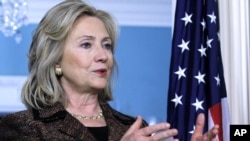
Secretary of State Hillary Clinton said Thursday the international community needs to be more united in pressuring the Syrian government to end its lethal crackdown on demonstrators. Clinton says the legitimacy of President Bashar al-Assad’s government has “nearly run out.”
Clinton says a Human Rights Watch report this week, framing Syrian actions against protestors as crimes against humanity, is in line with the State Department’s own reporting on the events.
She is lamenting the lack of an international consensus for stronger steps against the Assad government, including a U.N. Security Council resolution condemning Damascus.
At a joint press event with Czech Republic Foreign Minister Karel Schwarzenberg, Clinton listed U.S. actions against the Assad government to date, including sanctions targeting the Syrian ruling circle.
She noted that European states, with U.S. support, are circulating a draft U.N. Security Council resolution that would express grave concern about the situation in Syria and condemn the government’s use of violence.
But in apparent reference to China and Russia, which oppose U.N. action, Clinton said international unity on Syria is lacking. “Right now the attitude of the international community is not as united as we are seeking to make it. We do not yet have the agreement by some of the other members of the Security Council. We certainly have nothing resembling the kind of strong action the Arab League took with respect to Libya,” she said.
The Obama administration has kept a U.S. ambassador, Robert Ford in Damascus and has thus far not made an outright call for the departure of President Assad. But Clinton, asked if the Syrian president retains any legitimacy, said it is not yet gone, but has “nearly run out.”
“If he cannot end the violence against his own people, take meaningful steps to start a process of reform, then he needs to get out of the way. And every day that he stays in office and the violence continues, he’s basically making that choice by default,” she said.
The State Department said Thursday the United States is having political contacts with members of the Syrian opposition, many of whom met this week in Turkey and demanded President Assad’s resignation.
But spokesman Mark Toner declined specifics of those contacts, citing the political sensitivity. At the same time he acknowledged that Ambassador Ford has not been granted any recent meetings with ranking Syrian government officials.
Clinton Faults International Unity on Syria Crackdown