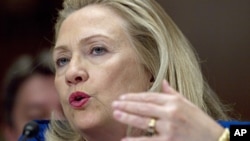
U.S. Secretary of State Hillary Clinton said Tuesday that there is an internal power struggle in Iran over the country's pursuit of nuclear weapons.
Secretary Clinton says the U.S. intelligence community believes Iran has not yet decided to produce a nuclear weapon, in part, because there are deep-seated disagreements among its leaders about whether it is the right thing to do.
“There is a continuing debate going on inside the Iranian regime," said Clinton. "And it's an especially complicated debate for anybody on the outside, and I dare say some people who are on the inside, to understand because there is a lot of power struggle going on. There are personality clashes.”
Clinton says that internal debate over the future of Iran's nuclear program includes members of the clergy, the Revolutionary Guard, the parliament and the presidency, leading to what she calls “a lot of static” in intelligence reporting on Tehran's atomic ambitions.
Much of the internal opposition to nuclear weapons comes from a fatwa issued by the late Ayatollah Hossein-Ali Montazeri. A leader of Iran's 1979 Islamic Revolution, Montazeri ruled that Islamic law forbids the development and use of nuclear weapons.
Iran says its nuclear program is for peaceful civilian purposes. Clinton says there is no doubt that Iran has the right to develop such a peaceful civilian program. But she told U.S. lawmakers on Tuesday that there is no doubt that much of what has been discovered by United Nations inspectors “points to the direction of a nuclear weapons program.”
The United States, Britain, France, Russia, China and Germany are considering Iran's response to a request to resume talks over its nuclear program. European Union foreign policy chief Catherine Ashton says she is cautious and optimistic that Iran might be ready to begin substantive talks.
There is added pressure to make progress on the issue as Israel reportedly considers preemptive military action to remove what it considers an Iranian threat.
Clinton says the international community is pursuing a dual track of intense pressure and a willingness to engage in talks.
“I want to gather as much information, not only about actions, but [also] about intentions," she said. "We have very deep, ongoing consultations with Israel, with the [Persian] Gulf Arabs, with the Europeans, with others. There isn't anybody of any stature in the world in any government that really is not concerned about what the Iranians are doing.”
Clinton says tougher U.S. sanctions against Iran are having an economic effect. As the world's third-largest exporter of crude oil, Iran is a major supplier for China, Japan and India as well as the European Union.
The United States is working with its European and Asian allies to dry up Iran's oil market because, they say, Tehran is using those profits to support its nuclear program.
Clinton: Internal Power Struggle in Iran Over Nuclear Weapons