



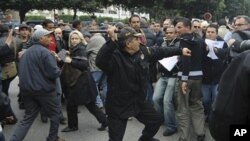
Years of anger and dissatisfaction in Tunisia over corruption, joblessness and other economic woes have erupted recently. What was unimaginable two months ago has taken place—Tunisia’s government shattered. Now, analysts are looking at other regimes in the region for signs of similar unrest. They do not have to look far. There have been self-immolations by protestors in Egypt, Algeria and Mauritania. Jordanians have demonstrated against high food prices. At an economic summit in Egypt, Arab League Chief Amr Moussa warned Wednesday that “the Arab soul is broken by poverty, unemployment and the general recession.”
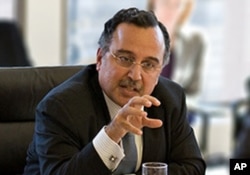
Nabil Fahmy, Dean of the American University in Cairo’s School of Global Affairs and Public Policy and a former Egyptian Ambassador to the United States, speaks with VOA's Cecily Hilleary.
Hilleary: Ambassador Fahmy, a third man has set himself on fire in Egypt. Are we seeing the beginning of a Tunisian style revolt in your country?
Fahmy: No, I don’t think so. I think what you’re seeing is a reflection of the region as a whole following what happened in Tunisia with tremendous interest. They were also quite surprised by how it unfolded in terms of the violence that occurred, the very large number of casualties and then by how quickly the Tunisian president left the country.
|
VOA's Cecily Hilleary speaks with Amb. Nabil Fahmy of American University in Cairo:
|
There’s also a bit of a “copycat” effect. In other words, people feel frustration—and obviously the people have emulated the process because of their frustrations and fears, concerns, feeling that this was the way to attract attention. I think it is a bit superficial to say what happens here can happen similarly in other countries.
Having said all that, it is alarming, yes. It is alarming to see what happened in Tunisia in terms of the violence between the government and the people. It is alarming to see people anywhere, even in my own country, feel obliged to put themselves on fire. That reflects that some people feel very frustrated.
Now, again, whether this is simply a “copycat” situation or a reflection of a greater problem, I think it’s too early to say. But I don’t really believe that this is something that will be repeated in a rapid fashion from one country to another.
But I think frankly, if I may say, that the Arab countries generally have to seize this occasion to learn the lessons from what happened in Tunisia, to look at their problems and how quickly and how effectively they are responsive to the concerns of their people. They have to seize the occasion to have a better relationship, a more symbiotic relationship between the executive organs and public opinion. And I say this across the board in the Arab world. I’m not talking about any country in particular.
Hilleary: Are we seeing that kind of examination of conscience in Egypt?
Fahmy: Well, again, my first answer is that it’s too early to tell. You can’t make a judgment on what’s happened over a few days since the Tunisian situation, particularly when you have an Arab summit now in Sharm el Sheikh on economic issues. Everybody’s busy with that.
But let me take you back a step before that. I actually think at the end of last year, we had one election and in the fall of this year we will have another, I think this whole year will be a year in which Egyptians look at themselves by way of the government looking at itself, by way of the people deciding what role they want to play because of the election process.
Hilleary: So what makes Egypt different from Tunisia?
Fahmy: One distinct difference between Egypt and Tunisia, for example, that serves the Egyptian situation is there’s no comparison whatsoever in terms of the freedom of the press in Egypt and what it was in Tunisia. There is an almost absolute free flow of information inside Egypt, and that was not accessible at all in Tunisia.
On the other hand, Tunisia has a much larger middle class and, frankly, the percentage of educated people in Tunisia is statistically much higher than almost any other country in the Arab world. So I mention positives on both sides—and problems on both sides—simply to emphasize that we all need to look at our problems.
But it is, I think, simplistic and superficial to assume that because it happened “here” it will happen “there.” Yes, you will see people saying, “If it happened here, maybe we’ll try doing the same thing in other parts of the Arab world.” And that’s why I don’t think that you’ll find this emulated quickly. I do believe it’s an occasion for all of the Arab world to learn the lessons and to develop a better relationship with the people.
Hilleary: There’s a scheduled demonstration on January 25 in Cairo, I understand, to which Mohamed ElBaradei is invited. Is there a possibility that it could spark something larger than just a peaceful, quiet demonstration?
Fahmy: Let me answer that in the following fashion: First of all, I’m not aware of the details of the demonstration. That being said, demonstrations have been allowed in Egypt over the last two or three years which you would never have seen in Tunisia; by the way, so there is a fundamental difference between the clamp down in Tunisia and the situation here. We’ve had demonstrations in front of Parliament for the last four years, on a regular basis.