



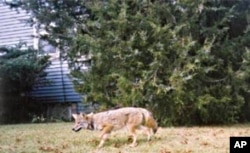
America's Wild West was known for the phantom howls of coyotes, which were often heard but seldom seen.
However, in the past 20 years, these desert dogs, indigenous to the North American wilderness, have been moving into suburbs and cities across the continent.
Urban coyotes
About two-dozen coyotes live at the Indiana Coyote Rescue Center.
Among them are Alex, Jane, and Loki, who were found as pups near a water treatment plant in Ohio. Center director, CeAnn Lambert, says the worker who found the wild dogs thought she was saving them by bringing them into the plant with her dog, who'd recently had puppies.
"She brought the dog into the treatment plant and let the coyote puppies nurse on the dog, which made them habituated to the dog and socialized to all the workers in the plant and they were deemed not releasable," says Lambert.
Whether finding their way onto airport runways in Dallas, Texas, or injuring toddlers in upstate New York, urban coyotes are becoming commonplace.
But, unless they're causing trouble, wildlife biologist Chris Anchor says most Americans are unaware that coyotes are living in their city and when they catch a rare glimpse of one, have no idea what they're really seeing.
"Quite often people will see them and just think they are someone's German Shepherd as opposed to a wild animal," says Anchor.

And they are wild animals. No one knows for certain why they began moving into metropolitan areas about two decades ago, but Anchor - who oversees a forest preserve near Chicago - says it may simply be their nature.
"They're extremely opportunistic. They're a species we call a generalist, so they are able to exploit the habitats that are available, even in close proximity to humans."
Unlike other wild animals - such as deer, Canada Geese and beavers - that have made themselves at home in urban settings - coyotes are predators, which often concerns their human neighbors.
Mitigating human-coyote conflicts
Exterminating coyotes isn't always practical or safe, so Anchor worked with fellow biologist Stan Gehrt, a professor at Ohio State University, to launch the Urban Coyote Project, to study the animals and learn how to mitigate human-coyote conflicts. Gehrt says what they found was surprising.
"For the most part these coyotes aren't nuisances at all. It's a little misleading for people because they only see the nuisances, the successful ones are the majority," says Gehrt. "And they're successful because you don't see them. They go about their business without impacting people."
He points out there are at least 350 coyotes in the Chicago area, with no recorded human attacks. In contrast, there are an average of 2,500 dog bites each year.

Keeping track
By trapping urban coyotes, taking fluid samples, radio collaring them, and tracking their movements, the biologists have learned a vast amount.
They now know the wild dogs are monogamous and live in small packs of about 6, with only the alpha male and female having a litter. Gehrt says they've also observed that coyotes learn much faster than domestic dogs do, and can safely cross busy highways and easily avoid traps set for them.
"The coyotes learn from us. They learn areas to avoid, certain traps to avoid, so then we have to adjust to them. So it's a constant game, if you will, between them and us. So we're constantly working on that as well."
Urban coyotes have also learned where the easiest food sources are - uncovered garbage cans and small pets left outside at night.
Gehrt says that means people need to change some of their behaviors. "I'm not telling people that they need to learn to live with coyotes because I have an affinity for coyotes and they're really neat animals, it's just simply the position they have put us in."
While living with wildlife in the backyard may pose some minor lifestyle changes for urban dwellers, both Gehrt and Lambert stress that coyotes provide an important service.
"They do have a place in our ecosystem. They can kill and take out the sick and the weak of other animals, they clean up carcasses," says Lambert. "There was a study done at Wolf Park years ago that found that one coyote, if only eating mice, can eat over 10,000 mice in a year."
As coyote sightings are reported from south Florida to Washington D.C. to California, Stan Gehrt emphasizes that these wild dogs are now in every major U.S. metropolitan area.
He's eager to see if the findings of his Urban Coyote Project hold true throughout the country. He says it's important that everyone is aware of these creatures, because whether we like it or not, coyotes are here to stay.