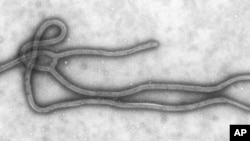



An international team of scientists has discovered a biochemical route used by the deadly Ebola virus to infect human cells. Scientists say the discovery points the way to new drugs that could prevent or treat one of the world’s most lethal viral diseases.
The Ebola hemorrhagic virus, which got its name from the central African river near where the disease first emerged in 1976, kills an estimated 90 percent of the people and non-human primates it infects.
The disease causes very high fever, both internal and external bleeding, and has led to thousands of deaths in many sub-Saharan African countries, including Gabon, Sudan, the Ivory Coast and Uganda, since the first reported outbreak 35 years ago.
Although considered a rare disease, Ebola causes panic whenever there is an outbreak, in part because little is known about where the illness comes from or how it spreads.
Experts believe infected bats may be one source of these sporadic occurrences of Ebola, and the disease is then spread from person to person through tainted body fluids or blood.
To better understand the biology of Ebola, a team of researchers at Albert Einstein College of Medicine, Harvard Medical School, the Whitehead Institute at MIT and the U.S. Army Medical Research Institute of Infectious Diseases studied how the virus actually infects cells.
Kartik Chandran, a professor of microbiology and immunology at Albert Einstein, is a senior author of the study.
“The critical step that we were studying is what we call viral entry," Chandran explained. "And it’s basically the step that results in the virus getting into the cytoplasm where the [genetic] goodies are for making copies of itself.”
Researchers looked at normal cell proteins that the Ebola virus might be hijacking, in effect, to get inside and infect mammalian cells. Investigators focused on one protein in particular - called Neimann-Pick C1 or NPC1.
Chandran says that in experiments with both human cells and in mice, the Ebola virus was unable to gain a toehold in cells that were missing the NPC1 protein.
“You couldn’t infect the cells with Ebola. And there are also mice that, like the human[s], don’t have the protein and develop Neimann-Pick disease," Chandran said.
The Neimann-Pick protein, which is embedded naturally in cell membranes, helps transport cholesterol throughout cells. People who are born with a rare genetic defect and don’t make the protein eventually die of Neimann-Pick disease, in which fatty substances called lipids collect and clog various internal organs.
Chandran says the disease progresses over time. But to prevent or treat an Ebola infection, he thinks it might be possible to design a small molecule that interferes with production of the Neimann-Pick protein in cells temporarily -- too briefly to cause problems with elevated cholesterol.
Chandran says such a compound would not have to totally block production of the NPC1 protein.
“You know the [Ebola] virus, it’s like ‘shock and awe.’ It’s like over within a week," noted Chandran. "I mean the virus grows very quickly and it kills off the very cells you need to mount your immune response. If we could stop that from happening or slow it down enough, we might give the person a chance.”
Chandran says scientists have developed a candidate drug that could be used to treat or prevent an Ebola outbreak. He says another hemorrhagic virus called Marburg uses a similar mechanism to infect cells and should also respond to a drug that blocks the Neimann-Pick protein.
Two articles by Chandran and colleagues on the biochemical keys involved in Ebola virus infections are published in the journal Nature.
Critical Protein Discovery Could Help Prevent Lethal Ebola Virus