



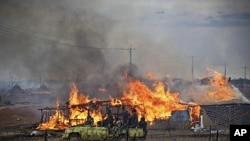
Efforts continue to find, register and provide assistance to the many thousands of people who’ve fled the Sudanese town of Abyei and surrounding region.
The exodus south began around May 20th, after fighting between northern and southern forces in the oil-rich area. The northern Sudan Armed Forces are now in control.
The International Organization for Migration [IOM] said the displaced are in urgent need of food, shelter and sanitation facilities. However, there are differing figures on the exact number of internally displaced persons [IDPs].
IOM’s spokesman in Juba, Gerard Waite, said the southern Sudan government estimates the number of IDPs at between 100,000 and 120,000. But the U.N. has a lower estimate of about 76,000. The IOM has registered about 40,000 of those.
Left in a hurry
“They left Abyei at very, very, short notice, of course, as is characteristic during the displacement for conflict reasons. They’ve brought very few items with them. There’s a very high proportion of women and children amongst the group. A lot of the energy people have…has been expended on moving their family and carrying their children,” he said.
The rainy season is making conditions worse.
“There’s very little natural shelter there. There are very few materials for which to build shelters and very, very few spare resources for the host communities to share with the displaced,” said Waite.
On the move
The migration from Abyei brought the displaced to Agok and beyond.
“The largest group of people that we have registered have moved further south than Agok. All the information we’re getting from Agok indicates that it’s quite a highly militarized area and therefore there’s a tendency for people to move onward fairly rapidly. Though we are fairly sure that there is quite a large population still in Agok,” he said.
It’s estimated that population may be as high as 5,000. Most of the displaced, however, are further south in Turalie, Wunrok and Mayon Abun in Warrap State.
Tracking teams
The IOM has tracking teams in Northern Bahr el Ghazal and Unity States.
“While the majority of people have moved more or less directly south, the pattern of displacement is quite varied. This is a very similar pattern that we saw during the displacement, which some may recall, in May of 2008, where actually quite a large proportion of the population from Abyei displaced during that period went to Northern Bahr el Ghazal. People obviously making their choices based on where they think they will be able to access the most resources,” said the IOM spokesman.
Choices may also be based on family or ethnic affiliations.
On the road
On Tuesday, an IOM convoy of 13 trucks left Juba carrying 140 drums of fuel to support humanitarian organizations aiding the displaced.
“We have a particular problem with fuel in that area. There has been for some time a restriction on commercial traffic between the north of Sudan and south Sudan. And so fuel resources in the area are scarce and there’s a risk, as yet, that fuel shortages will hinder the assistance operation,” he said.