



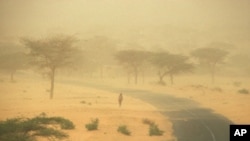
A lot of trees are dying in Africa’s Sahel region and new study says climate change caused by humans is to blame. What’s more, many tree species are also disappearing.
The study appears in the Journal of Arid Environments. Climate change scientist Patrick Gonzalez led the research on six countries. At the time of the study, Gonzalez was a visiting scholar at the Center for Forestry at the University of California at Berkeley.
“We conducted our research in the African Sahel, an arid region on the edge of the Sahara where people depend on trees for survival. And the Sahel has experienced the most severe drought in the world in the modern rainfall measurement record,” he said.
Drying up
The research shows that during the 20th Century rainfall in the Sahel dropped between 20 and 30 percent.
“One in six trees died in the last half of the 20th Century and, second, one in five tree species disappeared locally. And then third, together these changes shifted vegetation zones southward toward areas of more rainfall,” he said.
Possible causes of the vegetation shift include declining rainfall, growing human population and decreasing soil fertility.
“Our statistical comparison showed that climate outweighed the other factors. So, climate change was the main cause of the loss of the trees. Closer to the Sahara you have arid zone trees like Acacia with thorns. Very dry trees. And then as you move farther south towards the Equator, you have species that have fruits and hardwood and species that require more rainfall, that require moister conditions,” he said.
The study blames the climate change in the Sahel on motor vehicle and power plant emissions and other human activity over the years.
Gonzalez described conditions near the Sahara as long-term land degradation.
“So we actually are showing a form of desertification. Desertification is land degradation. We’re not showing a shift of the sands of the Sahara, but what we are showing is a degradation far south of the Sahara within the Sahel within the Sudan, within Guinea. Those are the zones south of the Sahara,” he said.
Adapting, averting
Local populations in the region have roots going back more than a thousand years and relocating is not an option. Indigenous people are adapting to climate change, for example, by caring for and pruning small trees until they're mature. Such a practice can help double tree density in a field.
However, Gonzalez said local populations cannot address climate change by themselves. He says the international community must act.
“The Intergovernmental Panel on Climate Change – that’s the top scientific panel that examines climate change and I sit on that panel – has shown that we, in the United States, and other industrialized nations have it in our power using current technologies and practices to avert more drastic impacts around the world by reducing our greenhouse gas emissions,” he said.
Gonzalez was joined in the research by Compton Tucker, senior earth scientist at NASA’s Goddard Space Flight Center and Hamady Sy, Mauritania’s country representative at the Famine Early Warning Systems Network. Both NASA and the U.S. Geological Survey provided funding for the study.