



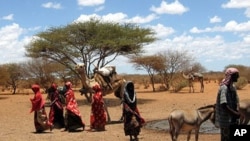
Somalia has one of the world’s worst humanitarian disasters, with hundreds of thousands of people displaced due to conflict. Now, a prolonged drought is adding to the country’s many problems. A top U.N. official says he wants the Somali people to know that aid agencies will do everything they can to help.
U.N. Humanitarian Coordinator for Somalia Mark Bowden has written an open letter to the Somali people. He says he “shares their fears and concerns.”
“Well. I think it’s very much on the basis of explaining to the Somali people what is happening to respond to the drought at the moment and the seriousness with which it’s being treated,” he says.
Deyr and Gu
The Deyr rains – the short rainy season between October and December – failed. Bowden says that’s had a direct effect on people’s health, especially children.
“We’re seeing for the first time very high levels of malnutrition in places in southern Somalia, where children are suffering rates of 30 percent acute malnutrition. Now the normal levels, which you start an emergency intervention, is 15 percent for acute malnutrition. So, it’s double the rate, which is unusual and the highest rates we’ve seen in 10 years,” he says.
And of course with a drought, water shortages are being reported in various parts of the country.
Bowden says, “We’re also seeing drying up of water sources, some communities having difficulty accessing drinking water. And at the moment, the beginnings of the loss of livestock and the livelihoods of populations in southern, central and parts of northern Somalia affected.”
The U.N. Humanitarian Coordinator says little if any relief is expected from the Gu rains – the main rainy season - which under good conditions would begin around April.
“We’ve just seen some recent climatology studies, which seem to suggest that the La Niña phenomenon will persist and will affect and reduce rainfall in the worst affected parts of southern Somalia and the Gu rains as well. So, the prognosis at the moment does not look too encouraging for that part of Somalia,” he says.
Digging for water
If nature won’t provide water in the form a rainfall, then it will have to be found elsewhere.
Bowden says, “We are in some areas paying for water trucking or the movement of water to communities. But at the moment, our priority is to deepen the boreholes that exist and to create a network of strategic boreholes, which provide both support for the people’s livelihoods to keep their cattle going and also for drinking water.”
If livestock start to die in large numbers, Bowden says many people may migrate back to the capital Mogadishu in search of food and other assistance. Hundreds of thousands of people have fled the city over the years to escape fighting between forces loyal to the Transitional Federal Government and various militias, including al Shabab.
The U.N. is allocating $60 million to address the immediate needs of the Somali people, but if the Gu rains fail more money will be needed later in the year. How much? Bowden estimates more than $150 million would be required just to meet the food needs.