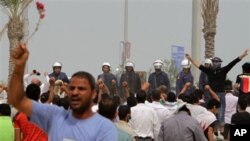
Unrest is marking the beginning of another week in some Arab countries, with several governments trying to disperse protesters.
An angry crowd of protesters in Bahrain’s capital, Manama, refused to give up a strategic highway they were blocking, after riot police used tear gas and rubber bullets to try to disperse them. Thousands of Shi’ite demonstrators continue to paralyze the capital’s key financial district.
Another group of protesters at Bahrain’s Pearl Roundabout also refused to budge after police tried to clear them out, using force. The demonstrators began blocking the roundabout in mid-February. Shi’ites, which make up 70 percent of Bahrain’s population, are demanding more political power from Bahrain's Sunni monarchy.
Yemeni security forces also fired tear gas and live ammunition for a second day in a bid to force students to vacate a protest camp near Sana'a University. Eyewitnesses say police and pro-government supporters also used wooden clubs and knives to attack the protesters. Dozens of casualties were reported.
Al-Jazeera TV reported that protesters in the southern Yemeni port city of Aden attacked and set fire to a police station for the second time in 48 hours. Al-Arabiya TV reported anti-government protesters also clashed with police in the city of Taiz, north of Aden, injuring several.
Yemeni protesters across the country have been demonstrating since mid-February, amid calls for the resignation of veteran President Ali Abdallah Saleh, who has offered sweeping concessions to the protesters.
In Lebanon, tens of thousands of supporters of the anti-Syrian March 14th coalition turned out in Beirut’s Martyr’s Square to commemorate the 2005 Cedar Revolution that forced Damascus to withdraw its troops from the country.
Caretaker Prime Minister Saad Hariri, who recently lost a no-confidence vote to the pro-Syrian Hezbollah and its allies, urged that the Shi’ite militia of Hezbollah be disarmed.
He says that he is calling for a state in which only the government is armed and a state that has only one army, rather than a state that has armies outside the army, states outside the state, and people who are outside the law who use their arms against the people.
Meanwhile, in Oman, the country’s ruler, Sultan Qaboos, issued a decree offering major powers for the first time to individuals outside the royal family. The decision follows several weeks of scattered, ongoing protests that have shaken the normally stable Gulf sultanate.
Demonstrations Intensify in Several Arab Countries