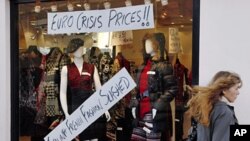



As Europe's fiscal concerns mount, relations between France and Britain are fraying as the two countries trade barbs over which economy is the worse off. The spat among historic rivals comes amid more gloomy economic forecasts out this week.
Slow growth and high debts have strained European Union ties this year, raising arguments that Europe must either bind closer together fiscally and economically, or face at least the prospect that the 17-nation eurozone might break apart. Britain - which is not part of the eurozone - made clear earlier this month it would not join a new fiscal pact championed by France and Germany.
That has strained relations with France. So have comments by French government officials - like French Finance Minister Francois Baroin.
In a recent radio interview, Baroin rejected any economic "lessons" from London. Britain's economy was very worrying, he said, adding that it was preferable to be French right now than British.
Reports say Britain has objected to these and other French remarks. But the bottom line, says Tomasz Michalski, a professor at the HEC business school in Paris, is that both France and Britain should be worrying.
"If you look at economic figures, both France and the United Kingdom are not doing especially well," said Michalski. "So they have high debt-to-GDP ratios - France has something which is approaching 90 percent; the UK is around 80 percent. Both are in danger of a recession. And therefore the prospects of both countries incurring more debt in the future are still large."
Ratings agencies - including Fitch Ratings on Friday - have warned a French downgrade is looming. That would be a blow to French President Nicolas Sarkozy's campaign for reelection next year.
"Sarkozy is very uneasy with France losing its triple A status just before the presidential elections," said Michalski. "That's because it would be on his watch - he would be responsible."
In fact, the outlook for Europe as a whole is gloomy. The European Central Bank in a report on Monday predicted tough economic times in 2012, with slower economic growth and a shortage of financing for banks. But in remarks to European lawmakers, ECB President Mario Draghi downplayed fears of a breakup of the eurozone.
"I have no doubt whatsoever about the strength of the euro, about its permanence, about its irreversibility….The one [single] currency is irreversible," Draghi said.
On Monday, European finance ministers agreed to inject $196 billion into the International Monetary Fund to help shore up struggling eurozone countries. But that sum fell short of the $261 billion European leaders agreed on earlier this month. Britain reportedly declined to contribute to the funding.
Economic Worries Spark French-British Tensions
- By Lisa Bryant