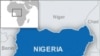



Nigeria’s economy is the second-largest in sub-Saharan Africa, after South Africa, but observers say that status is deceiving. They complain that Nigeria, despite billions of dollars of oil revenues and nearly 7 percent yearly economic growth, has failed to lift living standards for the average person.
Tony Iyare is a columnist and political consultant to Governor Adams Aliyu Oshiomole of the south-central state of Edo.
"More than 70 percent of Nigerians live on less than $1.00 per day," said Iyare. "We have one of the highest rates of maternal and child mortality. Nigeria may not meet the U.N. Millennium Development Goals [which aim for dramatic reductions in poverty and improvements in health care by 2015]."
"For a country that’s earned over $500 billion over the past 12 years [in oil money], it has not been able to put food on the table for its population, provide health care, schools, good roads and all kinds of services, [nor] hope for its teaming population," he said.
Power shortages
It’s not for lack of trying.
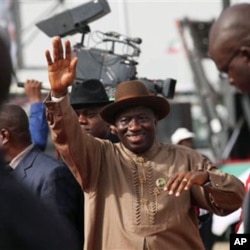
President Goodluck Jonathan of the People’s Democratic Party has introduced several measures to improve transparency and improve efficiency.
They include a proposed $10 billion plan to develop Nigeria’s gas reserves and its petrochemical and fertilizer industries. Jonathan says the venture should help create half a million jobs.
His administration also backs the ambitious Petroleum Industry Bill, which would improve transparency in contracts and increase government petroleum revenues, which would in turn help create a new fund to help develop often-neglected oil-producing communities.
Perhaps the president’s most publicized plan is to reform the ineffective Power Holding Company of Nigeria (PHCN). The state-run agency was originally named the National Electric Power Authority (NEPA), which many Nigerians said meant No Electric Power Anytime or Never Electric Power Again.
Iyare says things are so bad that companies have to rely on their own sources of energy to operate.
"The cost of doing business in Nigeria is 50 percent higher [than in other countries in West Africa]. It is easier to do business in [Ivory Coast and] Ghana, where there is power 24 hours a day," said Iyare.
"[Here], if you are engaging in production, you have to provide your own power, generate your own water, build your own roads and hire your own security. By the time you add this overhead, the cost of production is very high," he added.
Ambitious reforms
Jonathan has also proposed spending nearly $4 billion on a new electricity grid. The president predicts domestic power generation will increase from about 4,000 megawatts today to about 20,000 within the next four years.
Sola Tayo is a first-year associate fellow in the Africa Program at the London-based think tank, Chatham House.
"Goodluck Jonathan made headlines," she said, "with his plans to completely privatize the electricity sector. No one [before him] has gone as far as he is proposing. There were efforts by [former president Olusegun Obasanjo] to reform the power sector and let foreign companies bid for contracts, but what Jonathan is proposing is a… complete privatization of state-run power company, which I don’t think anyone has proposed before."
"Jonathan made a big splash with that and appointed a very respected Nigerian professor to oversee the process, Professor Bart Nnaji," added Sola Tayo."He is someone people admire, an innovator… not a light weight - but it remains to be seen whether this will make a significant difference to Nigerians and if power generated will increase So far, they’ve had interest from [investors] in Ireland, Canada, and India. It just remains to be seen whether they deliver, and if the government makes it easy for them to deliver."

Corruption
Observers say whether or not the country can be turned around depends on how leaders handle another important issue corruption. The World Bank blames the problem for the loss of $300 billion over the past three decades.
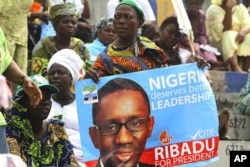
The issue has been a boon to two other presidential contenders with records of fighting graft: former general Muhammadu Buhari of the Congress for Progressive Change and Nuhu Ribadu of the Action Congress Party, who has served as chair of the Economic and Financial Crimes Commission.
On the other hand, some have less confidence in President Jonathan, who they say has surrounded himself with corrupt officials.
Emmanuel Iffer is a public commentator and former news editor for the Leadership newspaper in Abuja.
"His weakness," says Iffer, "is that he has people around him, supporters who are key organizers and planners, some of whom people are not happy with. People believe that for him to succeed, he should not have relationships with such characters."
"In the last 12 years of Nigerian democracy, some of these people have been in successive governments and Nigerians see them as people who have [failed] to move the country forward. Some people are worried about such people around him. They are suspicious they are likely to influence his decisions; [they do not think he has] a mind of his own," he added.
Observers note another characteristic common to most of the front-running candidates. Only the vice presidential candidate of the Action Congress Party of Nigeria, banker and businessman Fola Adeola, has any experience in the private sector.
Personality politics
Some complain that despite the importance of these issues, much of the campaign season has been devoted to personal topics, like the candidates’ religion or home region.
"Personalities have played a much bigger role in the campaigns, which is unfortunate," said Dr. Jibrin Ibrahim, the director of the Centre for Democracy and Development in Abuja. "The presidential candidates are not being judged on [where they stand on] the issues. Most simply [say] they will [provide] electricity, water or create employment without going into the details [of] how they will do that using the resources available at the country at this time."
Security
Jibril Ibrahim says one important topic that’s been ignored is security. In recent years, the government has confronted militants who say they are fighting for greater development of the oil-rich Niger Delta region. It has also faced inter-communal violence between Muslims and Christians in the country’s center, or Middle Belt and the emergence in the mainly Muslim northeast of the militant group Boko Haram - which translates as "Western education is sacrilege."
"It was clear to everyone as a serious issue," said Ibrahim. "The level of violence was quite high. In some parts of the country, there is low level insurgency that has persisted; in other parts, there have been communal conflicts of significant levels; banditry and armed robbery continue to be major problems. So, in the mindset of Nigerians, improving the security is an absolute necessity."
Ibrahim says Jonathan, who has helped oversee an amnesty for Niger Delta militants, has the support of many voters who want an end to violence in the region. But others say retired general Buhari, himself a northern Muslim, would be best to handle conflict in north and central regions.
Social cohesion
Besides security, Sola Tayo of Chatham House, say social issues have been neglected.
"There are issues people don’t like to talk about, like what it means to actually be Nigerian," said Tayo. "[Today], there [are] people not calling themselves Nigerian, but Yoruba, Ibo, Muslim, Christian [etc]…and that, combined with the way some people campaigned during the election, does not build a cohesive nation."

"They judge people based on their ethnicity or religion. That is something that needs to be addressed because if you look at what’s happened in some other African states, in particular, Ivory coast and what [former Ivory Coast president] Laurent Gbagbo did with his [nativist] campaign [making a distinction between who is a “real” Ivorian and who, in his view, is not], I think it can be quite dangerous if people don’t talk about these things on a grassroots level early on," said Tayo.
Observers say it’s not clear to what extent regionalism will determine the winner. They note that both President Jonathan and General Buhari enjoy support throughout the country. And they say that with the abundance of so many small ethnic and religious groups, it’s hard to be sure any single candidate has a complete lock on any given region.