


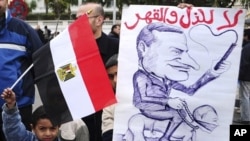
Tens of thousands of anti-government protesters have crowded into Cairo's Tahrir Square, chanting and waving flags as they rally for President Hosni Mubarak's immediate resignation.
Listen to Susan Yackee's Q&A with Luis Ramirez in Cairo
Protesters are calling Friday the "day of departure" for Mr. Mubarak, although the president vowed to finish his term in a speech earlier this week. There were no reports of clashes as in previous days between pro-Mubarak supporters and the demonstrators.
The protesters were joined in Tahir Square by Arab League chief Amr Moussa, a long time Egyptian political figure who has served as Egypt's foreign minister. France's Europe 1 radio quoted him as saying he may consider running for president but believes Mr. Mubarak will finish his term.
A smaller group of Mubarak supporters also gathered in Cairo but security forces prevented them from entering Tahrir Square.
Thousands of anti-government protesters also massed Friday in Alexandria, where they have been holding a peaceful rally. News reports says thousands of people are also attending anti-government rallies in Suez, Ismailia and other cities.
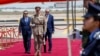
Egyptian Defense Minister Hussein Tantawi was seen visiting the square Friday for the first time since the start of the protests.
Friday's protests end a second week of anti-Mubarak rallies. On Wednesday, a violent clash erupted in Tahrir Square between government opponents and supporters.
President Mubarak said earlier this week that he will not seek reelection when his term ends. In a Thursday interview with the U.S. broadcaster ABC, he said he would like to leave office now, but fears Egypt would sink deeper into chaos if he did. Mr. Mubarak has ruled Egypt for nearly 30 years.
Mr. Mubarak blamed the Muslim Brotherhood - Egypt's largest and best organized opposition group - for the violence in the capital over the past few days. Protesters say Mr. Mubarak's supporters sparked the violence by attacking anti-government demonstrators on Wednesday.
At least eight people have died and nearly 900 have been injured in two days of fighting around Tahrir Square.
Prime Minister Ahmed Shafiq apologized for the clashes that broke out Wednesday. He called the violence a "disaster" and said it would not happen again.
Some information for this report was provided by AP, AFP and Reuters.