



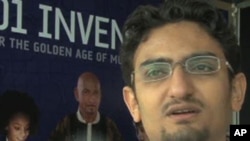
An exhibit on scientific breakthroughs in the Muslim world has opened in Los Angeles, and a leading Egyptian activist stopped by for a preview. Called 1001 Inventions, the exhibition chronicles the Golden Age of science in the Islamic world from the 7th through the 17th centuries.
Egyptian activist Wael Ghonim, who used Internet social networking sites to help spark a revolution, says technology has an important role in his part of the world today.
The Western system of numbers was spread by way of Muslim mathematicians, one of many contributions of the medieval Islamic world, a civilization that stretched from Spain to China.
Egyptian high-tech executive Wael Ghonim, currently on leave from Google, stopped by the California Science Center for a look.
He was in the United States to accept the Profile in Courage Award, given by the John F. Kennedy Library Foundation. He accepted the award, at the John F. Kennedy Presidential Library, on behalf of the Egyptian people.
Ghonim helped launch the revolution that toppled President Hosni Mubarak after 18 days of protests early this year.
“Social media and Internet, technology in general, was very instrumental in sparking the revolution in Egypt, and that just shows that you can actually use technology for the good to do things that theoretically seemed in the past impossible," he said.
Ghonim says new technology was well adapted to Egypt, where person-to-person interactions are important. He says exchanges on sites like Facebook became a political tool for young Egyptians.
“They used that as a way to express their opinions, as a way to collaborate and organize themselves - just say no to injustice, torture, and corruption," he said.
The science center exhibit, shown earlier in London, Istanbul and New York, explains scientific advances in the Muslim world in such fields as medicine, where doctors were using modern-looking surgical instruments 1,000 years ago. Visitors learn about inventors like Abbas Ibn Firnas, who created a glider in the 9th century.
Educator Maurice Coles develops school curricula on this period, which he calls the first global age.
“You've got people of every faith, of every background, of almost every culture and color working to a shared end. And so when you look around the exhibition, you'll see Christians, you'll see, obviously, Muslims. There are Hindus, there's a group called Sabeans that no longer exist, and they coexisted wonderfully well for a long period of time," he said.
Costumed re-enactors bring these innovators to life and explain their inventions. Interactive displays show advances in fields like art and architecture.
This flowering of ideas came at a backward time in Europe, says the science center’s Diane Perlov.
“It really was a flourishing of the arts and sciences at a time in the Middle Ages when Europe was in [what] most consider the Dark Ages," she said.
In the recent Tahrir Square protests, Egyptians embraced Internet social sites and mobile phones with digital cameras.
"In a highly connected world, where technology is bridging all the gaps, we need to understand that we are all the same and we have a lot in common, more than we have in differences. And that it's about time that we realize that. Everyone has a role to play in this world to get everyone closer to each other," Ghonim said.
And even if it does not usher in a new Golden Age, he says it will help the world get better.