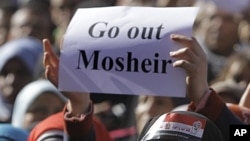



Egyptian women, embattled for decades under autocratic rule, are among the tens of thousands pouring into central Cairo’s Tahrir Square to celebrate the one-year anniversary of the popular uprising that toppled President Hosni Mubarak.
By early afternoon, Tahrir Square was packed with Egyptian women of all ages and backgrounds. Children stood side by side with their parents and grandparents amid a sea of people waving Egyptian flags.
Seventeen-year-old Israa says that she first marched in Tahrir Square in the first days of the protests.
A supporter of the Muslim Brotherhood’s Freedom and Justice Party, which commanded 47 percent of the vote in the recent lower house parliamentary elections, Israa is thrilled at the direction the country is moving.
"Things are better now for women, that they have more of an opportunity to play a role in society, politics and culture," she says via translator.
Some women in the crowd traveled for hours to take part. Mona Mohammed, from southern Egypt, says what impresses her most is that Egyptians seem to be acting in unison.
"We’re all standing together as one people," she says. "We’re all calling for our rights together as Egyptians."
But some women say reforms have not gone far enough. Throughout the morning, several speeches from "mothers of the martyrs" -- a group of Egyptian women whose sons died during last year’s anti-government demonstrations -- noted the lack of change under military rule since Mubarak's fall. Some speakers accused the military council of using repressive and violent tactics of the Mubarak era.
In late December, video showed female protesters being beaten, chased and stripped by black-clad riot troops during clashes between pro-democracy activists and Egyptian security forces. In one iconic scene, a woman is shown being stripped of her black veil and kicked in the stomach by the forces.
Since then, thousands of women have marched in Cairo demanding an end to violence against women.
On Wednesday, Nurhan, a student who declined to give her last name, carried a sign that said, “from January 25th 2011 to January 25, 2012, nothing has changed.” When asked if things are in any way better, she said that, at least for now, women can publicly campaign for their rights.
But activists say a push for increased rights for women has been sidelined as the country takes its first steps toward democracy.
Although women’s rights supporters saw some success late last year when an Egyptian administrative court banned so-called "virginity tests," which were reportedly performed on 17 women who were detained in the early days of the protests.
On the political front, only about eight women were elected to the new Egyptian parliament, just two percent of its powerful lower house.
Conservative Islamist candidates from the Salafi Nour party had greater success, capturing about 23 percent of the vote. Some women fear the Salafis want to undermine gains made by women and force them out of the workplace and into the home.
Israa, the high school student, says she’s not too worried, though. One of the first things she’d like to do after graduating is run for a seat in the emerging democratic parliament.
Egyptian Women Mark Year After Popular Uprising
- By Noel King