



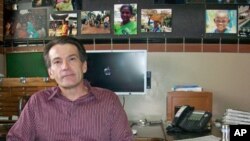
Even as a boy, Colorado State University engineer Bryan Willson says he was a tinkerer.
"I remember taking apart clocks and just about anything that had screws in it," he says. "That's the hallmark of an engineer is someone who's always trying to improve something."
Improving the human condition
As a graduate student, Willson was inspired to improve the human condition when he won a scholarship to study in India. He recalls the moment his plane began its final descent into the airport in New Dehli.
"As we got a few feet above the ground, you could begin to actually taste the air because of the unbelievable amount of pollution. And I recognized that there were really three sources to that: burning of wood, dirty diesel engines and two-stroke engines."
That experience led Willson to a lifelong mission of getting cleaner, more efficient energy to people in developing nations.
The rumbling machines at his Engines and Energy Conversion Laboratory are the key to that endeavor. Willson's team has developed a cookstove that produces less smoke for burning wood or any other fuel.

Cleaner cookstove
"It may be wood, dung, crop residues," says Willson. "We got a box from a colleague at M.I.T. containing yak dung. I didn't ask how she got it through the airport."
Willson himself goes through many airports to meet with businessmen, government officials and professors in Delhi and Bangalore and he treks into remote villages to explain the benefits of clean-burning stoves.
He's also making more trips to China, which is why he's learning Mandarin.
"Over the next 25 years, energy use will go up by 100 percent in China and probably 160 percent in India. If we're working on global solutions on energy and climate change, we really need to be engaged internationally."
Health impact
In addition to slowing climate change, Willson's cookstoves can can have a big impact on public health, according to Morgan DeFoort, co-director of the Engines Lab.
"Two to three billion people in the world cook on biomass fuels every day and most of that happens inside the home or in a three-sided enclosure that exposes women and children, primarily, to levels of air pollution that are easily a hundred times higher than the minimum standard set by the World Health Organization," says DeFoort.
Worldwide, respiratory illness caused by cookstove smoke kills as many people as malaria each year. DeFoort says the Engine Lab's version could change that.
"That device can save up to 50 percent of the fuel wood that is typically used by an Indian family cooking. It can reduce the emissions that they're exposed to by 80 percent.".
To build a market for his clean-burning products, Bryan Willson cofounded Envirofit.
The company focuses on developing environmentally friendly products to meet local needs in developing nations, starting with high-quality manufacturing, then setting up distribution and often microfinance to allow widespread dissemination. Envirofit has sold more than 125,000 of the clean-burning cookstoves and is increasing its capacity to soon sell millions.

Two-stroke engines
Willson is also focused on cleaning up the smoky, two-stroke engines that power many motorbikes, taxis and other vehicles in developing nations.
"In raw terms, a two-stroke engine puts out the pollution of about 50 modern automobiles, and you're looking at 50 to 100 million two- stroke engines, just in South Asia," says Willson. "So you're looking at over 2 1/2 billion car equivalents of pollution.
To change this, Envirofit offers a retrofit product that reduces two-stroke engine emissions by 90 percent, while increasing fuel efficiency by 45 percent.
Diesel pollution
Willson's team has also created ways to reduce diesel pollution.
They're researching how to grow acres of tiny algae plants for affordable, carbon-neutral biodiesel. And his team is testing energy smartgrids that might soon get electricity to the two billion people who don't have any.
Engine Labs Engineering Manager, Kirk Evans, says working on these projects is fun.
"Bryan is probably one of the greater visionaries in this type of work in our time," says Evans. "Just when you think you've tapped the back, he comes up with something new."
For his efforts at coming up with something new, Bryan Willson is listed among the inaugural Scientific American 10 - ten researchers, politicians, business executives and philanthropists chosen by Scientic American magazine, who have made a significant contribution to guiding science to serve humanity on a global basis.