



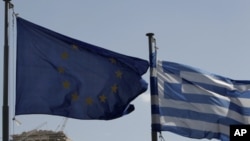
Greek Prime Minister Lucas Papademos and Finance Minister Evengelos Venizelos have resumed talks on debt writedown with international private lenders.
Officials close to the talks told reporters that progress was made late Thursday during the talks, which they said focused on technical and legal issues. Talks between the Greek officials and top bank negotiators, Charles Dallara and Jean Lemierre, are expected to continue Friday.
Several previous negotiating sessions have failed to resolve what interest rate the large financial institutions are willing to accept on the revised Greek bonds they hold. The lenders are pressing for a 4 percent rate, but European leaders are demanding 3.5 percent, to ease Greece's borrowing costs.
Earlier Thursday in Davos, Switzerland, the European Union's top economic official said that Greece's public creditors may have to deliver more financial aid to cut its staggering debt because a prospective deal with private lenders is not likely to be big enough.
EU economics commissioner Olli Rehn said Thursday in the Swiss resort town of Davos that he expects the Athens government will reach a deal in the coming days with the private creditors to cut about $130 billion from the debt Greece owes them.
"We are preparing a package which will pave the way for a sustainable solution for Greece, and in that package, yes, on the basis of the revised debt sustainability analysis, there is likely to be some increased need of official sector funding, but not anything dramatic in this case,'' Rehn said.
But he suggested that the 17-nation bloc that uses the common euro currency and the European Central Bank may also have to add money to the debt relief effort aimed at helping financially troubled Greece regain its economic footing over the coming years. It is an idea that numerous European leaders have opposed.
European leaders are pressing Greece to reach a new debt deal with its private creditors that by 2020 would cut the country's financial obligations to 120 percent of the country's economic output. But the prospective debt relief package with the private lenders would not reach that mark, and perhaps leave a funding shortfall of as much as $19 billion.
Greece's European neighbors are demanding that it reach an agreement on the debt relief and impose more unpopular austerity measures before they will approve a new $169 billion bailout, the country's second in two years. Greece says that without the new funding, it will default on its financial obligations in March.
Some information for this report was provided by AP, AFP and Reuters.