


European countries have been accused of a totally inadequate response to the refugee crisis on Libya's borders. Hundreds of thousands of mainly sub-Saharan migrants were forced to flee Libya following the brutal crackdown on anti-government protests earlier this year.
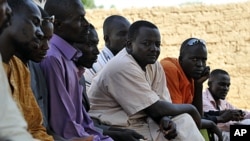
Refugees take shelter from a sandstorm at the Shousha camp on Tunisia's border with Libya.
The sweeping political change in both countries has done little to change the lives of the people stranded in this desolate camp.
Human rights group Amnesty International says they are being forgotten by the outside world.
Charlotte Phillips is a refugee activist for Amnesty.
"Many are from countries such as Somalia, Sudan, and Eritrea, countries where we know there are conflicts and people are being persecuted," said Phillips. "These are people who have been displaced not just once, but twice. They've been forced to flee from their homes and they've been forced to flee again from Libya."
Libya under Colonel Moammar Gadhafi attracted hundreds of thousands of migrant workers from across Africa and beyond.
The outbreak of conflict in February forced them to flee.
"They also suffered grave human rights abuses at the hands of both pro- and anti-Gadhafi forces," added Phillips. "Many sub-Saharan Africans were targeted and accused of being mercenaries."
Shishay Tesfay shelters behind a tent along with several of his Eritrean compatriots at the Shousha camp. He was living in Tripoli when anti-government protests began in February.
"We got into a little bit of trouble because of the Libyan people demonstrating," Tesfay recalled. "And we were afraid for our lives; we tried to escape to save our lives. You can see life is a little hard because the climate is like a desert. We live in tents… you can see all the tents here burned out. And if just one tent burns, almost 40 tents will be destroyed."
Amnesty says just eight European countries have offered fewer than 700 asylum slots between them, and as Europe took part in the NATO bombing of Libya, it has a duty to take action.
"European countries can and must resettle refugees," added Phillips. "These are people who have already been recognized as refugees. Relatively speaking, we are talking about quite small numbers of people. We're talking about 5,000 refugees, so around 3,800 in Shousha refugee camp [in Tunisia] and 1,000 in Egypt."
Tens of thousands of refugees from Libya have already reached Europe by crossing the Mediterranean on dangerously overloaded boats.
It's estimated 1,500 people have drowned.
Amnesty International says more and more refugees are resorting to returning to Libya, to try to board boats for the perilous journey across the Mediterranean.