



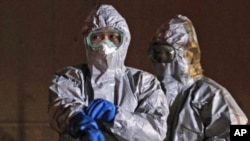
An American nuclear expert says radiation from Japan could spread across the Pacific and reach the United States if a complete meltdown occurs at a Japanese nuclear facility damaged as a result of last week’s earthquake and subsequent tsunami.
Nuclear expert Joseph Cirincione of the Ploughshares Fund says Japan’s nuclear crisis is in a critical phase.
"One of the [Japanese] reactors has had half the core exposed already. This is the one they are now flooding with seawater in a desperate effort to prevent a complete meltdown."
Cirincione spoke on the Fox News Sunday television program. He said the Fukushima Daiichi nuclear plant on Japan’s northeast coast is one of at least three nuclear facilities at risk.
Japan has evacuated civilians from areas surrounding the troubled plant, but Cirincione says radiation could spread far beyond Japan if efforts to contain the crisis fail.
Explosion at the Fukushima nuclear plant
"The worst-case scenario is that the fuel rods fuse together - temperatures get so hot that [they] melt together into a radioactive molten mass that busts through the containment mechanisms. So they spew radioactivity into the ground, into the air, into the water. Some of that radioactivity could carry in the atmosphere to the west coast of the United States."
Japan’s ambassador in Washington, Ichiro Fujisaki, acknowledged potential dangers, but said no complete nuclear meltdown appears imminent.
"It is true that part of [the] fuel rod may have been deformed or melting. But it is not a situation where [the] core reactor, the substantial part of [the] reactor, is melting down."
The ambassador spoke on NBC’s Meet the Press. Also appearing on the program was the head of the U.S. Nuclear Energy Institute, Marvin Furtel, who praised Japan’s response to the nuclear crisis. Furtel said a meltdown at a nuclear power plant does not always result in a massive release of radiation, as America’s own history shows.
"At Three Mile Island [in Pennsylvania], which was the worst accident we ever had, about half of the core melted, so about 50 percent. It resulted in no [radiation] releases off-site that threatened anybody. So, you can have fuel melt, and if the rest of your safety systems, your containment, works and you manage to keep the reactor under control, the dangers for public health and safety are really minimal."
Some U.S. legislators are suggesting heightened scrutiny of America’s nuclear energy program in the wake of Japan’s crisis. Independent Democratic Senator Joe Lieberman says new nuclear facility construction should be placed on hold pending a full assessment of potential risks. But the Senate’s top Republican, Minority Leader Mitch McConnell, says it would be a mistake to make domestic energy decisions based on fears surrounding a tragedy in another nation.