



For refugees, starting over in a new country can feel like landing on a new planet. It’s difficult enough to understand daily life, much less face the challenges of finding a job.
In America’s Pacific Northwest, a program to ease the refugee resettlement experience is helping people put down new roots, literally, through agriculture.
But learning to be an American farmer can be a tough row to hoe.
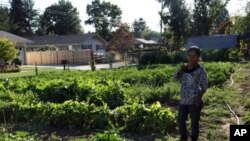
A few years ago, a small plot in southeast Portland, Oregon, was an empty lot. Now, it’s a densely-planted farm. Tomatoes are ripening on the vines and the lemon cucumbers are nice and juicy.
Learning curve
David Beller, the farm’s coordinator, is not happy with the fields. “Everyone come here, and feel how dry this is. I can’t believe this stuff is even alive.”
The farmers Beller is working with are refugees from Bhutan, a small, landlocked country in the Himalayan highlands, on China’s southern border.
Their translator says, "Oh, they thought that they doesn’t have to put water in.”
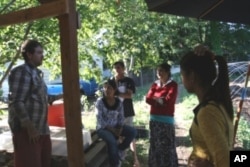
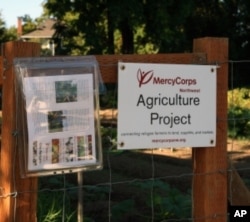
The refugees-turned-farmers arrived in Portland a couple of years ago and are now part of the New American Agriculture Program at MercyCorps Northwest. The group is known for its international development work, but a local division helps people in Washington state and Oregon.
“We started working with refugees, engaging them in urban agriculture in 2004, with the motivation that food is a connector, and there was growing interest in local food," says John Haines, who directs the local program. "And the refugees were coming with motivation, some skills in growing.”
Putting down roots
The idea of small urban plots, where people can earn supplemental income close to their homes, is now a part of refugee resettlement programs all over the country. There are Somali Bantus farming in Boise, Idaho, and refugees from Burundi growing crops in Seattle, Washington.
When Bal Tiwari moved to Portland from a Nepalese refugee camp, he was excited to have the opportunity to farm again. In fact, he was just glad to discover that America had farms.
“He said that he never thought that he’ll get an opportunity to work in the farm," says the translator who is interpreting for Tiwari. "Because they said that America doesn’t have any kind of agriculture production, and he thought he’ll get all the things from out of country.”
Becoming an American farmer is a big adjustment for refugees. First, they speak very little English, and often have little formal education, which limits their ability to use most training materials. They also have to adapt to a different climate. Back in their home countries, many refugees practiced a casual subsistence agriculture, cultivating fruits and vegetables for their families. Here, they produce a marketable crop on dense, urban plots.
“For example, these farmers are really into planting beans spaced out farther than I like," farm manager David Beller says. "And they’re convinced that it’s the best way to grow beans, and they’re easier to pick and better quality. And I’m convinced of exactly the opposite. So there’s a healthy tension between different practices.”
Going to market
The learning process doesn’t end at the harvest. MercyCorps staff also teach farmers how to grade their crops for the American market and how to pack it so that it won’t bruise. The hard work is paying off.
The Portland plots now produce enough vegetables to sell to local farmers’ markets, a few restaurants and members of their Community-Supported Agriculture program. And the benefits go beyond the economic.
“They get some connectivity to the wider community. They’re comfortable getting on a bus going across town, they get comfortable with selling at a market," director John Haines says. "So we find it’s a way to bridge isolation as much as provide a modest income.”
And, of course, there are also the edible benefits, as a translator relays for Pabi Tiwari. "They are getting the fresh vegetables and the fresh fruits. They don’t have to pay in market. It’s kind of free food and fresh food.”
Although, as Nisha Basnet laments, it’s not quite as good as back home. "We have a very sour tomato in Nepal, and here it is kind of sweet or something. It doesn't taste good like Nepal.”
The Nepalese farmers hope that they’ll someday be able to get seeds for their native tomatoes and beans, and grow them right here in the Northwest.