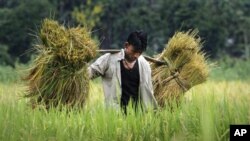



The United Nations estimates that nearly one billion people, about 15 percent of the world's population, are malnourished and do not get enough food to eat. This Saturday, the U.N. is marking the 30th anniversary of World Food Day to highlight the issues behind poverty and hunger.
As part of VOA's special coverage of this issue, we interviewed Howarth Bouis, Director of HarvestPlus, a Washington-based non-profit group. Bouis says in some areas of the world, what food is available has little nutritional value.
What is your organization doing to make food more nutritious?
We have a crop that we're working on in Asia… a Pearl Millet [Pennisetum glaucum] for India. We have high iron varieties of Pearl Millet that we'll be able to release in two years time. Pearl Millet is a crop that is not as favored as wheat and rice, so it's eaten by the poor. So we're planning our delivery strategy now. We're finishing up the breeding. We're doing some of the nutrition studies that need to be done. We haven't had a chance to initiate the delivery. We're trying to do the same thing with high zinc rice and wheat varieties in Asia.
What kind of reaction are you getting from the areas of the world where people don't have enough to eat?
There are several different sectors that we have to get on board in order to make this happen. The first is the plant breeders. We're giving them a new breeding objective. Normally they want to increase yields. They want to breed for disease resistance. They are worried about raising the profits and the incomes of farmers. We're saying, "Add this to the things you are breeding for. Put more vitamins and minerals, in addition to those other qualities."
Initially there was some negative reaction. [Farmers said] "Look we've got a lot of work to do. Let nutritionists take care of nutrition, we'll take care of increasing yields."
We were able to explain to them about the problem of malnutrition in developing countries that generally the plant breeders were not aware of. They learned what they could to do to help the situation and now we've really got a large community of plant breeders on board. Nutritionists are paying attention. They're starting to get on board. We have other studies in the pipeline. They always want to see additional evidence, so we're providing that. Now the final group that obviously that we have to get on board are the farmers and the consumers.
Has there been any problem of getting this out, or is it a matter of convincing the rest of the world that this will be beneficial to them?
The one difficulty that we're having is that it takes so long. Plant breeding is a process that takes seven or eight years. That whole process from the start to the end and getting an official release of a variety in a developing country takes eight to 10 years, so it's very difficult to get the funding and the sustained interest in a project where you
say you're only going to have impact eight to 10 years from now. That's been our big difficulty.
Hunger in Focus: Three Questions with HarvestPlus