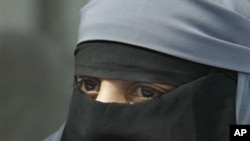
France's Cabinet has approved draft legislation banning the face-covering Islamic veil. If the bill is passed, France could become the second European country after Belgium to ban the garment.
There was little doubt that France's center-right Cabinet would pass the draft legislation to ban the face veil. The next step is for French deputies to vote on the measure. The vote is slated for July and Parliament is expected to pass the measure. Last week, the deputies unanimously adopted a resolution condemning the face-covering veil as an affront to French values.
If the legislation goes into force, women wearing the garment in public places would be fined about $185. Those found forcing women to wear the face veil are subject to even stiffer sentences - a fine of up to $18,000 and a year in prison.
Very few women actually wear the face veil in France. The government estimates fewer than 2,000 women wear the veil out of a total Muslim population of up to six million. But the ban's supporters say the measure would send a strong signal in favor of women's rights and France's staunchly secular creed.
France's Islamic population is divided over the measure. Some support a ban - like one young French woman, called Kahina, who was interviewed by French radio.
Kahina agreed that the face veil, also called the burqa here, violated women's rights. But others, like another Muslim woman Anissa, feels a ban would unfairly target the Muslim community.
Anissa, who wears a veil that does not cover the face, believes a ban on the face veil stigmatizes Islam. She notes other Islamic symbols that have also come into question in Europe - notably minarets on mosques and the headscarf in public schools.
If the legislation is passed, France could become the second Western European country to ban the veil. Belgium's lower house voted for a veil ban last month and the senate is expected to approve it in a separate vote. The French government foresees a six-month period before enforcing a ban, allowing time to explain the legislation and push women to abandon the garment.
If the legislation is passed, France could become the second Western European country to ban the veil. Belgium's lower house voted for a veil ban last month and the senate is expected to approve it in a separate vote. The French government foresees a six-month period before enforcing a ban, allowing time to explain the legislation and push women to abandon the garment.
But the legislation still faces stumbling blocks. France's State Council, the country's highest administrative body, has warned it may be unconstitutional. And some Muslim women have threatened to take the matter to the European Court of Human Rights.
French Cabinet Approves Islamic Veil Ban
- By Lisa Bryant